
In what is expected to be the final tournament of her illustrious 27-year tennis career, Serena Williams stepped onto the court in the first round of the US Open in Flushing, NY, wearing custom Nike shoes emblazoned with 400 hand-set diamonds.
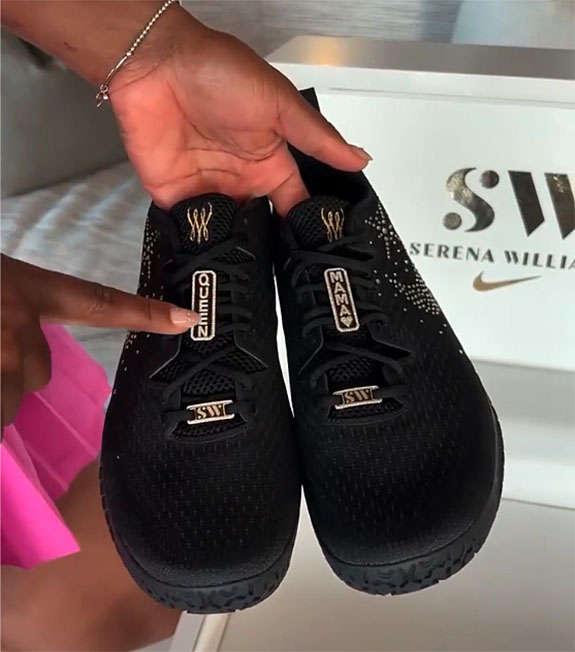
Prior to the match, which she handily won in straight sets over Danka Kovinic, the 23-time Grand Slam champion shared an unboxing video on Instagram where she called the shoes "epic, flashy and amazing."
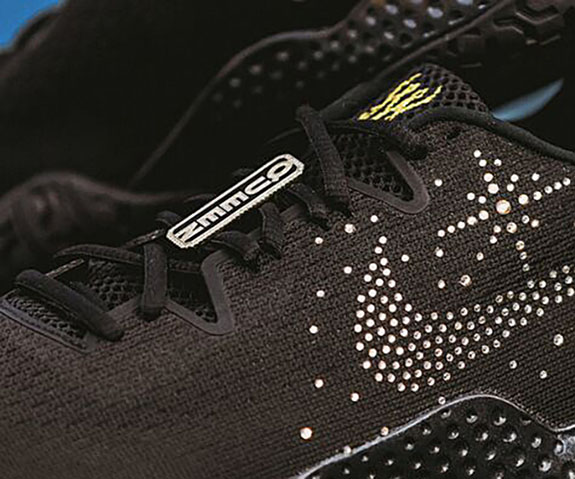
Williams pointed out that Nike collaborated with Serena Williams Jewelry to modify the PE NikeCourt Flare 2 shoes to include solid gold lace deubrés (ornamental shoelace tags) that spell out "QUEEN" and "MAMA" in glistening diamonds against a ground of black ceramic. The Swooshes are rendered in Swarovski crystals.
She concluded the video by joking that the shoes were too nice to wear on the court.
"I can't just wear these, right?" she asked. "I just need to let them sit in this box in my bedroom. This is so wild and so crazy and I've never worn better shoes for the Open. I am excited. Thank you, Nike."
On its website, Nike noted that Williams took a hands-on-approach to designing her 2022 look.

She paired the blinged-out black shoes with a black outfit inspired by the graceful competition dresses worn by figure skaters. The crystal-encrusted bodice alludes to the night sky above center court in Flushing. The six-layer skirt is a nod to her six prior US Open titles.

Having beaten Kovinic 6-3, 6-3 in the first round of the 2022 US Open, the 40-year-old Williams will set her sights on second-seed Anett Kontaveit in round two. This will be their first-ever meeting on the WTA tour and it's expected to be a barn burner.
The 26-year-old Kontaveit told reporters that she was rooting for Williams in the first round and relished the opportunity to play against her. The match is slated for Wednesday at 7 p.m. ET and can be seen on ESPN, ESPN2 and the ESPN App.
"I'm really looking forward to it," she said. " I'm not sure if I'll ever experience something like this again."
Credits: Serena Williams' unboxing screen capture via Instagram / serenawilliamsjewelry. Apparel photos by Nike. US Open photo by Edwin Martinez from The Bronx, CC BY 2.0, via Wikimedia Commons.
With all the recent internet buzz over asteroids strewn with precious metals and exoplanets where it rains liquid rubies and sapphires, we found this a perfect time to unpack a story we originally published in the summer of 2014 about a dwarf star made completely of diamonds.

Fifty light-years away in the constellation Centaurus is a white dwarf star two-thirds the size of the Earth that's likely the galaxy’s largest diamond weighing in at 10 billion trillion trillion carats.
Given the pet name “Lucy” by astronomers in deference to the Beatles’ famous song, “Lucy In The Sky With Diamonds,” the dwarf star is officially known as “BPM 37093.” It is 4,000km in diameter, and likely the coldest white dwarf ever detected.
“You would need a jeweler’s loupe the size of the Sun to grade this diamond,” joked astronomer Travis Metcalfe, who led the team that studied it at the Harvard-Smithsonian Center for Astrophysics.
Today, Metcalfe runs the Golden, CO-based White Dwarf Research Corporation, a non-profit organization dedicated to scientific research and public education. He also heads up a non-profit adopt-a-star program to help fund research.
The white dwarf star is the compressed dying remnant of what used to be a star very much like our Sun. Once a star uses up its fuel, it shrinks in on itself and starts to cool off. Since it’s made mostly of carbon, the crystallization of the super-dense material produces a diamond.
Before you think about planning a mining expedition to Lucy, take note that her super-cool temperature (compared to other stars) is still a blistering 5,000 degrees F, nearly twice the melting point of steel. Our sun at its core is about 27 million degrees F.
White dwarf stars are nearly impossible to identify because they are extremely difficult to see. Lucy, for instance, shines with only 1/2000th of the Sun’s visual brightness. Lacking visual clues, astronomers have relied on other methods to pinpoint a white dwarf in space. In the case of Lucy, she happens to do an “orbital tango” with a pulsar, or fast-spinning neutron star.
Metcalf noted that in five billion years our own Sun would likely meet the same fate as Lucy. It will cool down, shrink, crystallize and become a huge diamond in the center of our solar system.
“Our sun will become a diamond that truly is forever,” said Metcalfe.
Credit: Image by Harvard-Smithsonian Center for Astrophysics / Travis Metcalfe, Ruth Bazinet.
There are few things in the world Philadelphian Sarah Keller loves more than a pint of Milk Jawn's delectable Troop Leader-flavor ice cream. So, when her boyfriend, Paul Kimball, planned to pop the question recently, he conspired with the brand's founder and CEO, Amy Wilson, to make the romantic event even more special.
“Oh my God, I was totally honored,” Wilson told The Philadelphia Inquirer. “I thought it was amazing.”
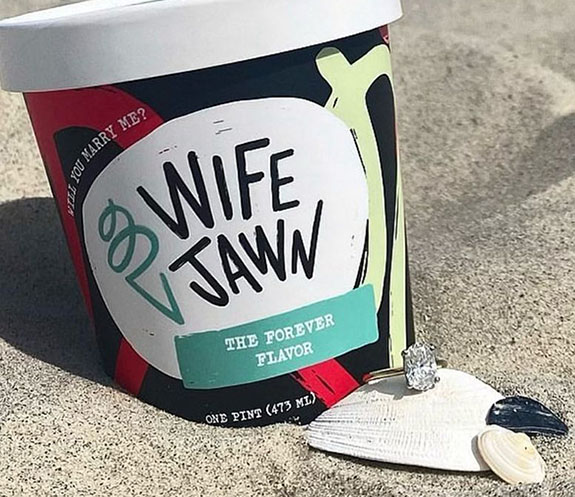
Wilson and Kimball worked with the brand's design firm to create a custom pint that would look and feel like a conventional Milk Jawn product, except for a few key modifications.
Milk Jawn would be rebranded as "Wife Jawn" and the variety would be called "The Forever Flavor."
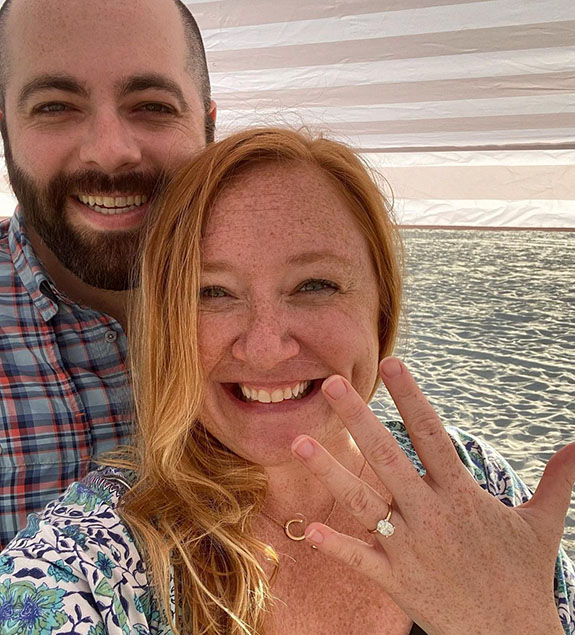
Ice cream played a vital role in the couple's courtship. After the their first dinner date back in February of 2021, Kimball told Keller that he needed to stop by his house to pick up something special for the second part of the date, which would take them to a nearby park.
It was a pint of Troop Leader, a creamy mix overflowing with Thin Mint Girl Scout cookies. Keller had revealed her ice cream preference during an earlier online conversation.
“I thought it was incredibly sweet that he had picked up on the fact it was my favorite ice cream and he planned ahead,” she told The Philadelphia Inquirer. “It was just one of the signs of his thoughtfulness, and an early sign of how wonderful he is.”
On August 14, Kimball had the professionally designed pint container of Wife Jawn stowed away in a backpack during the couple's romantic getaway to Sea Isle City Beach, just south of Ocean City, NJ. Kimball had requested an empty container because he knew the ice cream wouldn't survive the beach day and because he wanted to save it as a keepsake.
After several hours at the shore, Kimball told his girlfriend that he had brought along some ice cream. Sarah shot back that there's no way ice cream could have stayed frozen in a backpack for that long.
“I pulled out the pint and handed it to her," he said, "and while she was reading [the label], I used it as a distraction get down on one knee to propose.”
Keller was overwhelmed with emotion as her boyfriend presented her with an oval diamond mounted on a simple gold band.
"I looked down and he was kneeling in front of me with his cute little face holding the ring,” she told The Philadelphia Inquirer. “He said some sweet things to me, I don’t remember what they were, and then he asked me to marry him.”
Of course, she said, "Yes" — even though the container was empty.
On its Instagram page, Milk Jawn told the romantic story and posted pics of the custom ice cream container and the newly engaged couple.
“It’s our most-liked post out of everything we’ve ever posted,” Wilson said.
Although the wedding date and venue have yet to be determined, Keller is certain about one thing: Ice cream has to be on the menu.
“And if it can be Milk Jawn, all the better,” she said.
Established in Wilson's kitchen back in 2012, Milk Jawn has grown into a Philadelphia-area favorite. The delicacy is made Philly-style (without eggs), using local Pennsylvania dairy products.
The word "jawn," if you were wondering, is Philadelphia slang for literally anything. The noun can stand in for objects, places, people and events. As the website guidetophilly.com explained, "jawn can mean nothing and everything."
Credits: Images via Instagram.com / milkjawn; Instagram.com / kellahhhhhandpaul.kimball.
Donning a headlamp and wetsuit, 60-year-old metal detector enthusiast Lou Asci waded waist-deep into the Atlantic Ocean off the coast of New Hampshire to rescue a diamond wedding ring lost a week earlier by 29-year-old Francesca Teal. It was the third time Asci searched the site.

“I don’t take failure all too well,” Asci told The Boston Globe. “I wanted to go back and give it one last shot.”
Teal had lost her cherished family heirloom on August 6 while tossing a football with her husband, Austin, in the shallows at North Beach in Hampton, NH, about 40 miles north of Boston. The soldered-together engagement ring/wedding band combo carried extreme sentimental value because the rings had been passed down from her great-grandmother.
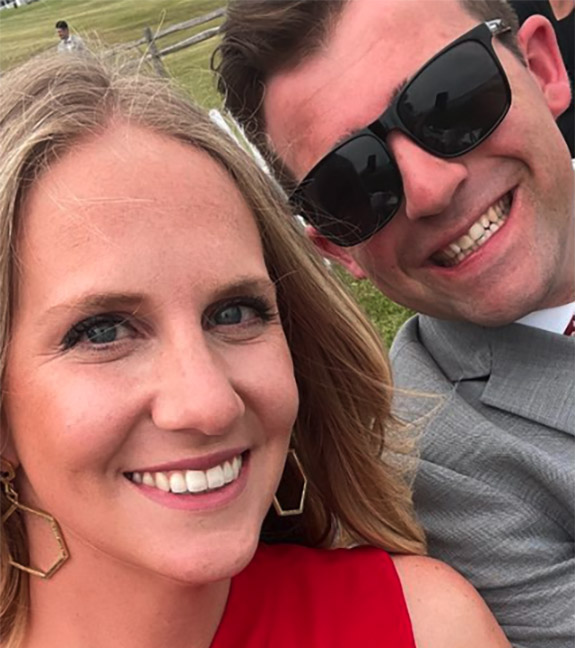
“This one throw hit my hand, and I saw the ring pop off my finger and go into the water,” Teal told The Globe. “In that moment, my heart dropped.”
Austin marked the approximate spot the ring hit the water. They borrowed a pair of goggles from a nearby beachgoer, but couldn't find the ring. After two hours, the gave up.
When the got home, Teal then turned to social media for help. She posted a plea and a reference photo on the Hampton Beach Residents & Friends Facebook page.
She wrote," “Hello! Long shot here… earlier today I was at The Wall, North Beach, Hampton N.H. & unfortunately lost my wedding ring in the ocean. We searched for hours with no luck… hoping this gets to anyone who might have a metal detector and goes to North Beach frequently. It was in front of/around the 18th street area… just hoping if someone does happen to find it it can make its way back to me… I appreciate all the help from those on the beach today looking as well. Here’s a photo for reference… thank you!”
Members of the Facebook page enthusiastically shared Teal's story and before long it caught the attention of Asci, a resident of Marshfield, MA, who wrote to Francesca and told her, "Don't lose hope." He was on the case.
Asci failed in his first two attempts to find the ring, but on the third try — on August 14 — he decided to venture further out into the surf.
“It was getting late, it was getting dark, and the tide was coming in,” Asci told The Boston Globe. “I decided to go out deeper than where I thought it was.”
The water was higher than waist level when he got the hit he was hoping for. The ring had been buried under four inches of sand.
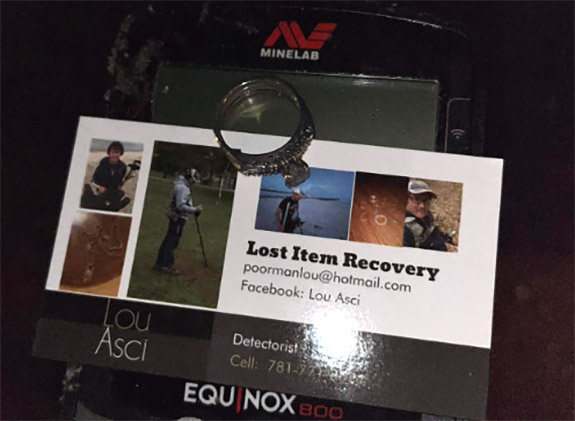
Asci sent Teal a photo of his find along with a comical tongue-in-cheek message: “Please tell me this is the ring so I can finally get off this beach.”
The hero ring finder even traveled to the Teal home so Austin could place the ring back on Francesca's finger.
Teal returned to the Hampton Beach Residents & Friends Facebook group to report the great news and to credit the numerous people who helped in the efforts to get her ring back.
“My ring was found and has been brought back to me!” she wrote. “Thank you to everyone who shared that post, sent well wishes or prayed to St. Anthony. But mostly thank you to Lou Asci & all the other very kind, generous & inspiring strangers that took time out of their days to search for it."
She commented that she was overwhelmed by the kindness of strangers.
"It has been so amazing to witness humanity in this positive way & has brought so much faith to myself & others," she added. "People helping people, I will always extend my hand to others in the way you all have showed to me. As my Dad would say, ‘Do good, be good.’ Thank you, thank you, thank you.”
Ironically, Asci found a second ring — a men's wedding band — while searching for Teal's ring. He shared news about his find on the Hampton Beach Residents & Friends Facebook group and is hoping to return it to its rightful owner.
Credits: Images courtesy of Francesca Teal.
A Pennsylvania family enjoying a vacation at Rehoboth Beach, DE, expected the trip would net a lot of quality time and a bounty of souvenir mugs and T-shirts. What they got as a bonus was a rare purple pearl and a memory of a lifetime.
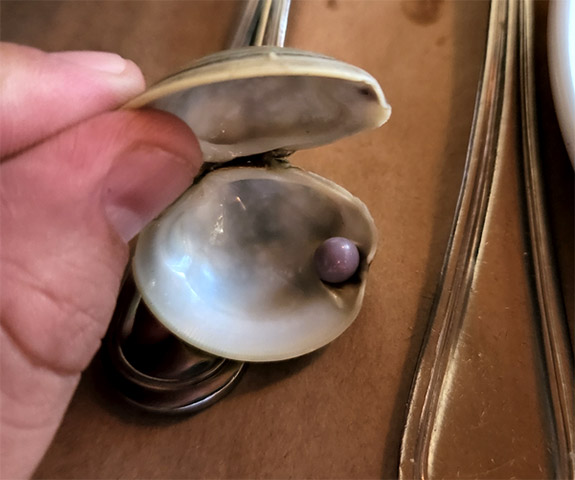
Scott Overland of Phoenixville, PA, was finishing up his littleneck clams appetizer at Salt Air restaurant when he encountered a hard object.
“I thought I bit down on a piece of shell or something,” Overland told delawareonline.com. “My wife thought it was a piece of candy because it looked like those candy dots.”
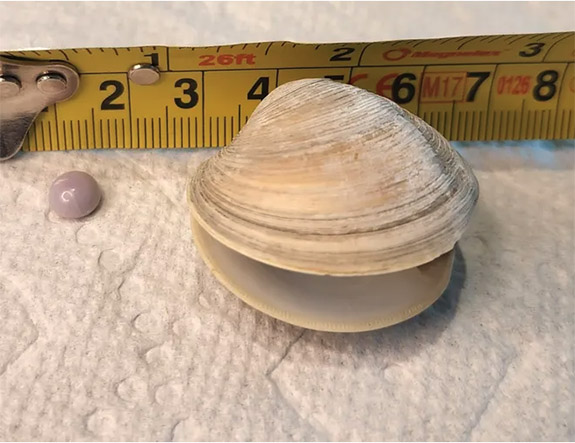
The bright lavender object was domed at the top and flat on the back, similar to the button candies that come on a paper roll. But, when Overland inspected the inside of the clam shell, he noticed an indentation where the pearl had grown. He placed it there and it fit perfectly.
“We had never heard of a pearl in a clam," he added. "I always thought they came in oysters.”
Overland has since learned that natural pearls do, indeed, grow in clams. They are very rare and a single specimen — depending on the size, quality and shape — can be worth thousands of dollars.
Pearls found in clams are classified as non-nacreous and have a porcelain-like appearance. Pearls grown in oysters present a deeper glow caused by layers of nacre that refract the light.
Natural pearls are organic gems, created by a mollusk totally by chance, without human intervention. Cultured pearls, by comparison, are grown under controlled conditions, where a bead is implanted in the body of the mollusk to stimulate the secretion of nacre.
Clams served at the Salt Air restaurant are the popular northern quahog variety grown by Cherrystone Aqua Farms in the Chesapeake Bay. A spokesperson for the grower's parent company, Ballard Clams and Oysters, told delawareonline.com that he hears about diners finding pearls in their clams or oysters two or three times a year.
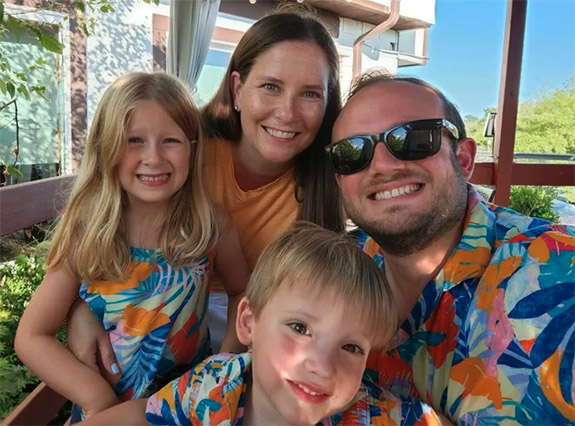
Overland, 37, told Fox 5 DC that he was planning to get the pearl appraised and had no immediate plans to sell it.
He said that the craziest part of the story is that the clams were nearly returned to the kitchen uneaten because they came with a pepper garnish that Overland's wife didn't care for.
They decided to accept the appetizer as it was presented and were rewarded with a glistening gem.
“It’s a fun story and a fun memory,” Overland told delawareonline.com.
Credits: Images courtesy of Scott Overland.
McDonald's Netherlands is encouraging the proper disposal of trash by giving away limited-edition jewelry inspired by discarded fast-food packaging. Among the items are gold earrings made to look like empty dipping sauce containers and a red crystal pendant resembling a slightly scrunched french fry box.
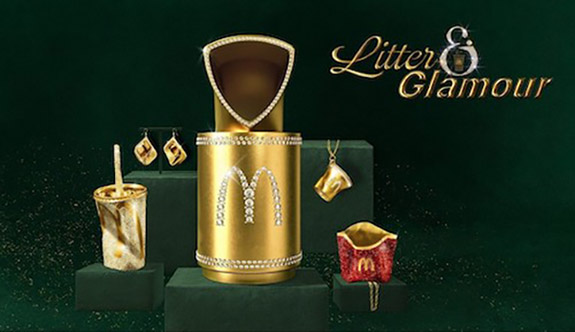
Created by the TBWANeboko ad agency, the “Litter and Glamour” campaign includes 258 participating restaurants, each of which has installed a special golden trash can. Customers who drop their waste in the special receptacle between August 16 and September 12 are automatically entered to win one of the seven unique items from the collection.

A 30-second commercial supporting the campaign shows how an average McDonald's customer can become a red-carpet celebrity by simply throwing her rubbish in a bin. The spot shows the woman finishing up a drink in a McDonald's parking lot and throwing out the cup. Then the scene transitions to a fantasy starring the same woman and the same drink. This time the paparazzi and fans watch breathlessly as she walks toward a golden trash can and tosses the cup inside. This woman is a winner, of course, and she joyfully shows off her reward — a dazzling french fry box necklace. The master of ceremonies explains, "In this way, we make the neighborhood a little more beautiful."
“Turning seemingly worthless items you find in the streets into valuable jewelry is very disruptive, especially when you stimulate people to throw away their waste into a bin and have the chance to win it back as a limited collection of McDonald’s jewelry," Darre van Dijk, chief creative officer for TBWANeboko, said in a statement. "Now that’s how you encourage good behavior!"
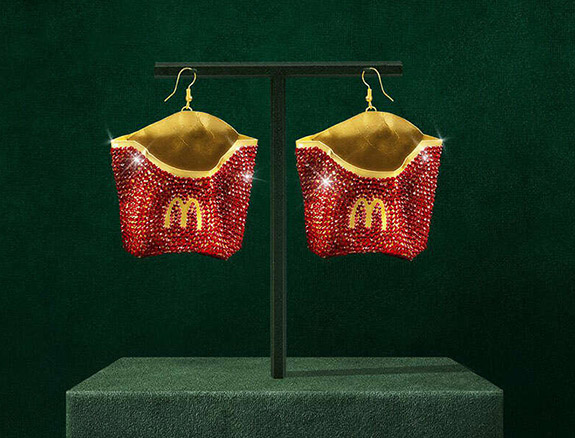
An independent notary will determine in advance the time, date and location of each winning trash deposit. The customer who drops trash in a golden receptacle at that exact time (or the who is first after that moment) will be the winner.
In addition to the dipping sauce container earrings and the french fry box pendant, the collection includes a milk shake lapel pin, a Big Mac box ring, a coffee creamer pendant, a soft drink cup pendant and mini french fry box dangle earrings.
The design and fabrication of the collection is the result of a collaboration between the sixth-generation jewelry firm De Vaal and casting specialist Bronze Special Art.
The anti-littering campaign carries on the messaging of McDonald's previous initiatives called "You Bin It, You Win It" (2020) and "Trash Dance" (2021).
Currently, 91% of the product packaging used by McDonald's in the Netherlands is made from renewable, recycled or certified materials. The goal is 100% by 2025.
Check out the “Litter and Glamour” commercial here...
Credits: Jewelry photos courtesy of McDonald's. Paparazzi screen capture via Youtube.com / TBWANEBOKO.
Welcome to Music Friday when we bring you wonderful songs with jewelry, gemstones or precious metals in the lyrics or title. Today, the much-beloved Olivia Newton-John reminds us in her inspirational 2006 song, “Pearls on a Chain,” that all of us have been touched in some way by cancer.
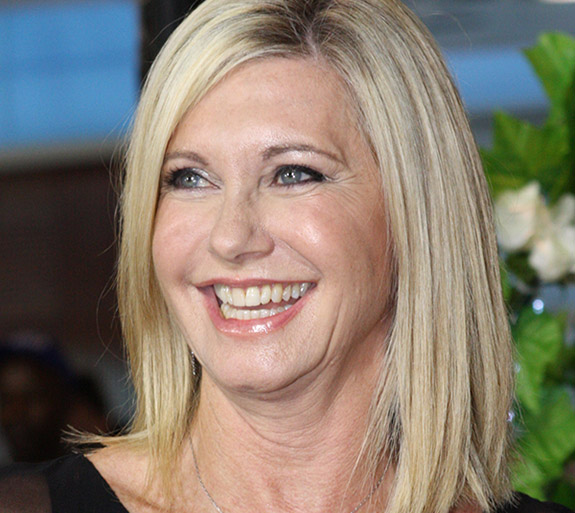
She sings, “Every little thing that I am, so you are / And if you look in my eyes / You will see we are souls alike / We are pearls / We are pearls / We are pearls on a chain.”
After surviving breast cancer in 1992, Newton-John became a staunch advocate for cancer patients and their families. In 2008, she raised funds to help build the Olivia Newton-John Cancer and Wellness Centre in Melbourne, Australia.
The world shed a collective tear when the singer-actress-activist lost her decades-long battle to the dreaded disease last week at the age of 73.
In describing her motivation for writing “Pearls on a Chain,” Newton-John reminded Aussie concert-goers in 2008 how cancer has likely touched all of them in some way.
“Perhaps it’s someone in our family or someone that we know, or a friend of a friend,” she said. “I know that over the years I'd get calls once a month and now twice a week from someone who has a friend that’s going through it, and in that way we’re all connected — like pearls on a chain.”
“Pearls on a Chain” is the second track on Newton-John’s Grace and Gratitude album, which she released in 2006 and distributed exclusively through Walgreens pharmacies to benefit various cancer charities.
It was re-released with normal distribution in 2010 as Grace and Gratitude Renewed. That version charted in Australia and the US, with the album earning the #2 spot on the US Billboard New Age Albums chart and #36 on the US Billboard Christian Albums chart.
Born in Britain and raised in Australia, Newton-John was a 1970s singing sensation with a flood of #1 hits that included “I Honestly Love You” and “Have You Never Been Mellow.” In 1978, she played Sandy Olsson opposite John Travolta’s Danny Zuko in the wildly popular musical, Grease. She was 29 when she convincingly portrayed a high school exchange student from Australia.
The four-time Grammy Award winner has sold more than 100 million records and is considered one of the best-selling music artists of all time.
In September 2018, she revealed that she was being treated for cancer at the base of her spine. Previously, she had battled breast cancer during the early '90s and again in 2017.
She passed away on August 8, and as a sign of respect and admiration, many landmarks in Melbourne and Sidney, Australia, were specially lit in her honor.
We invite you to check out the video of Newton-John performing “Pearls on a Chain” at Sydney's State Theatre in September of 2008. All the proceeds from the event went to the Olivia Newton-John Cancer and Wellness Centre Appeal. The lyrics are below if you’d like to sing along...
“Pearls on a Chain”
Written and performed by Olivia Newton-John.
Every living thing on this earth has a heart
Every little thing that I am, so you are
And if you look in my eyes
You will see we are souls alike
We are pearls
We are pearls
We are pearls on a chain
Every day my sunrise will dawn where you are
Every night we sleep underneath the same stars
And if we stand face to face
We will see love’s amazing grace
We are pearls
We are pearls
We are pearls on a chain
And if you look in my eyes
You will see we are souls alike
We are pearls
We are pearls
We are pearls on a chain
We are pearls
We are pearls
We are pearls on a chain
… on a chain … on a chain
Credit: Photo by Eva Rinaldi, CC BY-SA 2.0, via Wikimedia Commons.
Thanks to summer shoppers who continued to spend on "experiences and goods that make them feel good," the retail jewelry sector posted another terrific month, with July 2022 recording a startling triple-digit increase compared to the pre-pandemic figures of July 2019.

Mastercard SpendingPulse™, which measures in-store and online sales across all forms of payment, reported that July's jewelry sales performance was up 18.6% over July 2021 (YOY) and a whopping 109.1% over July 2019 (YO3Y).
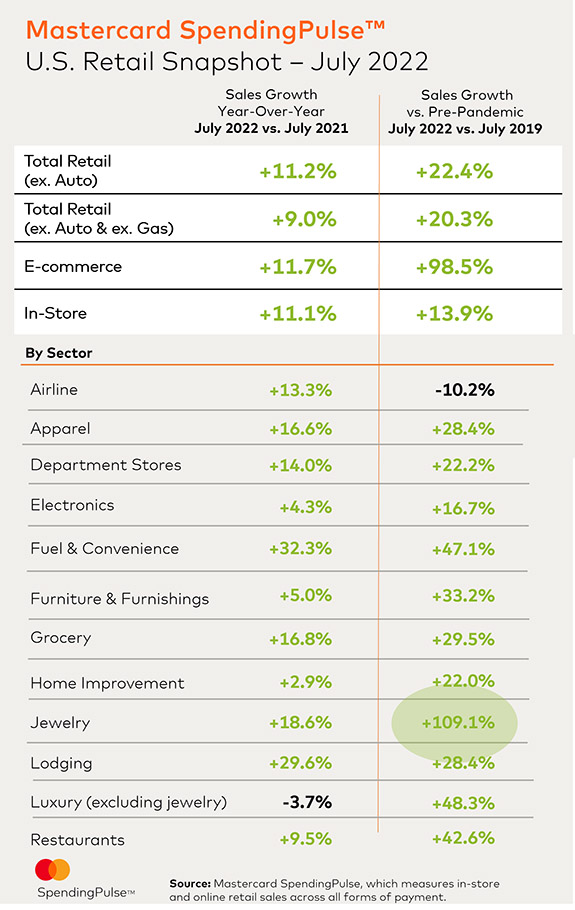
The jewelry sector's YO3Y growth outpaced all other sectors by a wide margin.
“The latest retail trends place an emphasis on consumer choice and passion-driven spending," said Steve Sadove, senior advisor for Mastercard and former CEO and Chairman of Saks Incorporated. "They’re hunting for deals, shopping across channels and ultimately still spending on experiences and goods that make them feel good.”
Interestingly, luxury items (excluding jewelry) were down 3.7% during July 2022 compared to the year before. It was the only sector in Mastercard's list to be mired in negative territory.
Despite rumblings in the marketplace about inflation and a possible downturn in the economy, consumers were undaunted when it came to pulling out their credit cards. Total retail sales in July 2022 (excluding auto) were up 11.2% YOY and 22.4% YO3Y, with both in-store and e-commerce sales enjoying YOY increases of more than 11%.
The credit card company noted that road-trippers saw some relief at the pump and travel remained a priority with lodging up 29.6% YOY and airline sales up 13.3% YOY.
Mastercard SpendingPulse™ findings are based on aggregate sales activity in the Mastercard payments network, coupled with survey-based estimates for certain other payment forms, such as cash and check.
Credits: Shopper image by Bigstockphoto.com. Table courtesy of Mastercard SpendingPulse™.
NASA's highly anticipated summer 2022 mission to "16 Psyche" — a 140-mile-wide asteroid made of gold, platinum, iron and nickel — has been postponed due to the late delivery of the spacecraft's flight software and testing equipment.

A 15-member independent review board is currently re-evaluating the costs and benefits of the Psyche mission before NASA can reschedule the launch. The results, to be released in late September, will have heavy implications for space-mining entrepreneurs who are looking to capitalize on what could become a quintillion-dollar industry.
When we first wrote about 16 Psyche in the summer of 2019, NASA had no immediate plans to do any mining on the asteroid and it was deemed way too large to tow back to Earth.
But, during the past three years, in the run-up to the actual launch, scientists described how a SpaceX Starship, for example, could theoretically orbit the asteroid while mining robots worked the surface. The Starship would be capable of carrying upwards of 100 metric tons of ore to facilities in low-Earth orbit for processing.
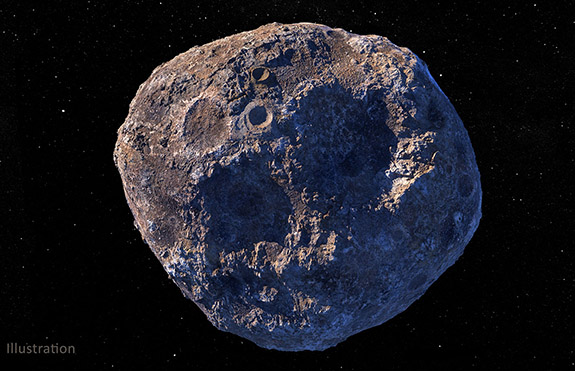
The value of 16 Psyche's natural resources is hotly debated. The estimate of $700 quintillion (700 followed by 18 zeroes) lies on the high end of the spectrum while $11.65 trillion occupies the low end. The wide discrepancy is rooted in one estimate that assumes the precious metals run throughout the asteroid as opposed to only the surface.
A team of researchers from Purdue University and Brown University suggested that the "golden asteroid" — which orbits the Sun between Mars and Jupiter — was less dense than previously believed. They argued that 16 Psyche is actually a rocky object covered with a layer of metal that erupted from the core.
The US government has already made legal preparations for the eventuality of space mining. The SPACE Act, which became law in 2015, includes provisions for private companies to extract resources from asteroids with limited government interference. Although the law does not allow for companies to claim, say, an asteroid, for their own, miners may keep anything they obtain from their exploration and mining.
Beyond the precious metal implications, NASA and its university partners were excited to explore 16 Psyche because it appears to be the exposed core of an early planet, perhaps the size of Mars, that lost its rocky outer layers due to violent collisions that occurred while the solar system was forming.
Measuring about 140 miles (226 km) in diameter, Psyche 16 is named after the nymph Psyche, who, according to Roman mythology, married Cupid but was put to death by Venus. At Cupid’s request, Jupiter — the king of the Gods — made Psyche immortal. The unique metal asteroid was discovered in 1852 by Italian astronomer Annibale de Gasparis.
NASA's original plan was to launch the Psyche spacecraft in the summer of 2022 from Florida’s Kennedy Space Center. After a 1.5-billion-mile, 3 1/2-year journey, the NASA spacecraft would have arrived at the asteroid in 2026.
If the review board gives the project a thumbs-up in September, the launch date is expected to be rescheduled for 2023 or 2024.
Credits: Orbiter illustration by NASA/JPL-Caltech/Arizona State Univ./Space Systems Loral/Peter Rubin. 16 Psyche illustration by NASA/JPL-Caltech/ASU.
Throughout much of history, gem "experts" couldn't distinguish a ruby from a spinel. It was not until 1783 that spinel — August's newest official birthstone — was recognized as a mineral distinct from its far more famous red lookalike.
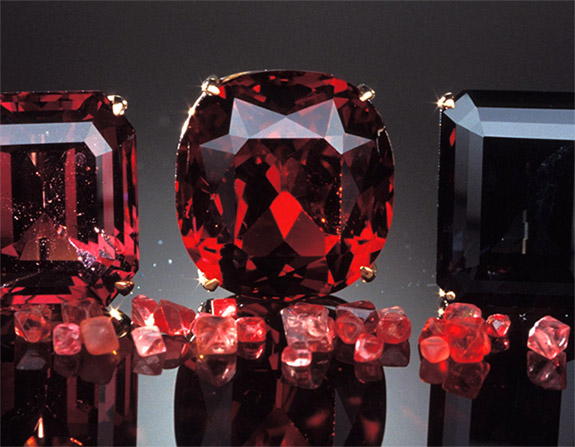
Ruby is composed of aluminum oxide, while spinel is made of magnesium aluminum oxide that forms when impure limestone is altered by extreme heat and pressure. Both gems get their reddish color from impurities of chromium in their chemical structure. In nature, they are often found side by side.
The physical similarities between the two gems created a jumble of confusion evidenced in these high-profile blunders.
Catherine the Great commissioned the Imperial Crown of Russia in 1763 and never knew that the impressive “ruby” topping the regal headpiece was actually a spinel.
At her coronation in 1838, Queen Victoria wore a newly designed Imperial State Crown, which prominently displayed the 170-carat Black Prince Ruby. It turned out to be a spinel.
The 361-carat Timur Ruby, which was presented by the East India Company to Queen Victoria as a gift in 1851, also was a misidentified spinel.
In Burma (now Myanmar), the high luster, perfect octahedral spinel crystals found in the Mogok region have a special name, according to the Smithsonian. They are called "anyon nat thwe," meaning spinels that have been cut and polished by the spirits.
In 2016, the American Gem Trade Association (AGTA) and Jewelers of America (JA) announced jointly that spinel would join peridot as an official birthstone for the month of August. The news came as a surprise to gem aficionados because the modern birthstone list — up until that point — had been amended only a few times during its 100-plus-year existence.
Established in 1912 by the American National Retail Jewelers Association (now known as JA), the modern birthstone list saw a significant change in 1952 when alexandrite (June), citrine (November), tourmaline (October) and zircon (December) were added. The list was amended again in 2002 when tanzanite joined the group of December birthstones.
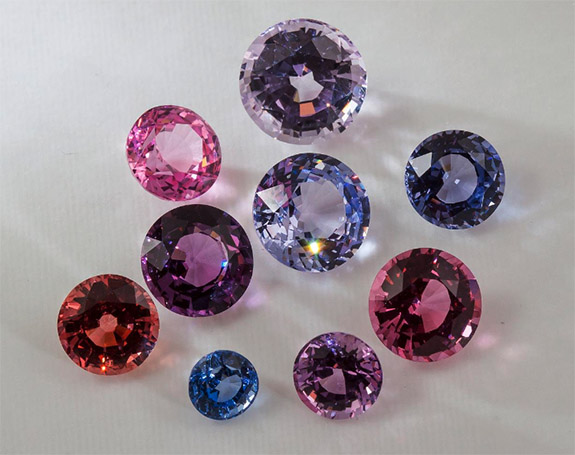
According to the Smithsonian, pure spinel is colorless, but impurities give rise to a range of colors, most typically pink or red, but also purple, green and blue.
The spinels on this page are from the Smithsonian’s National Gem Collection.
The leading sources of spinel are Myanmar, Sri Lanka and Thailand, while other significant spinel production takes place in Pakistan, Afghanistan, Tajikistan, Tanzania, Vietnam and Russia.
Spinel is a durable gem with a hardness of 8.0 on the Mohs scale. By comparison, diamond rates a 10 and ruby rates a 9.
Credits: Spinel trio (top) by D. Penland / Smithsonian. Spinel grouping (bottom) by Ken Larsen / Smithsonian.