
Fura Gems just unveiled "Estrela de Fura," a rough 101-carat, gem-quality ruby that's being described as a "once in a century" discovery. The company's chief executive believes the rough gem, which was unearthed in Mozambique, could eventually yield a faceted stone weighing 50 carats or more.
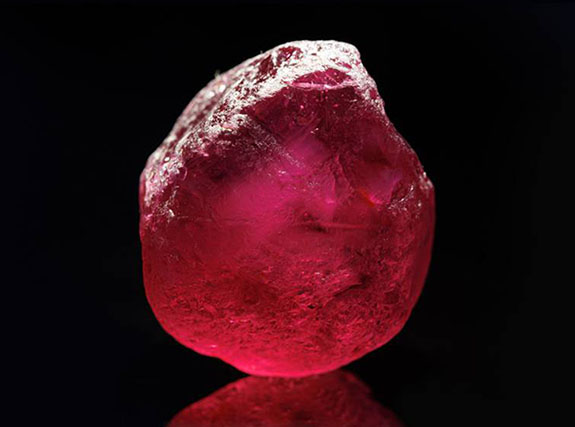
If that's true and the quality of the stone is on par with the 25.59-carat, cushion-cut “Sunrise Ruby” that sold at auction in 2015 for $30.4 million, Estrela de Fura (Portuguese for "Star of Fura") may be worth $50 million or more in its final polished form.
Estrela de Fura will be looking to unseat the Sunrise Ruby, which currently holds two auction records: The largest sum ever paid for a ruby and the highest price-per-carat ever paid for a ruby ($1.19 million).
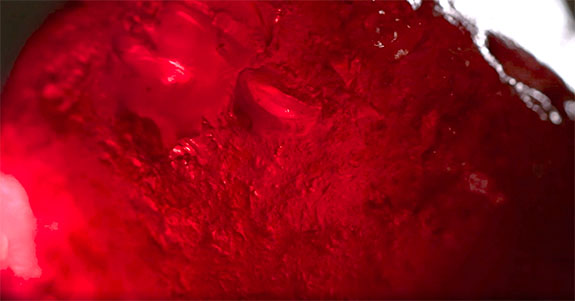
The international press got its first look at the pigeon-blood-red Estrela de Fura during yesterday's press conference at the lavish 68-story Almas Tower in Dubai.
Dev Shetty, Fura Gems' chief executive, told thenationalnews.com how he received a call from the company's master sorter, Balbir, on July 24. He had unlocked a storage box and spotted something large, red and shiny. The sorter told Shetty, who was in Bangkok at the time, "I think we found something amazing."
Dr. A. Peretti, CEO of GRS GemResearch Swisslab, confirmed the sorter's hunch.
"This ruby shows characteristics normally encountered only in the classical Mogok mines of Burma," he told khaleejtimes.com. "It possesses a fluorescence and vivid red color, and even excels in its excellent clarity. Estrela de Fura provides the potential to achieve the new world record of being the finest gem-quality ruby ever found with a size of over 50 carats once it goes through the final cutting process."
For the next 45 days, Fura Gems, which is billing Estrela de Fura as "the world's largest gem-quality ruby ever mined," will be setting up appointments for potential buyers to view and assess the stone at the Dubai Diamond Exchange. Shetty told thenationalnews.com that the potential buyer could represent a cutting house, jewelry brand, collector or even a museum. A private auction is set to take place in October.
The UAE-based Fura Gems currently mines rubies in Mozambique, emeralds in Colombia and sapphires in both Australia and Madagascar.
Credits: Estrela de Fura image courtesy of Fura Gems. Screen shot closeup via Twitter.com / Furagems.
Lonsdaleite, a mysterious hexagonal form of diamond that's even harder than the common cubic variety, is likely the result of a catastrophic collision between a dwarf planet and a large asteroid 4.5 billion years ago, according to a new study.

An international team of researchers confirmed the existence of the cosmic gem in slices of ureilite meteorites, a rare type of space rock that is believed to be material from the mantle of dwarf planets. The team studied 18 ureilite samples that had been sourced in northwest Africa and southern Australia.

“We have discovered the largest lonsdaleite crystals known to date that are up to a micron in size – much, much thinner than a human hair,” noted RMIT Professor Dougal McCulloch, who was one of the senior researchers involved in the study.
So far, the exact hardness of lonsdaleite has been difficult to confirm because the minute sample sizes do not allow for a scratch test. Lonsdaleite is believed to be 58% harder than an Earth-sourced diamond, which is saying a lot because conventional diamonds register a perfect 10 on the Mohs hardness scale. Might the scale need to be amended in the future to include a 10+ or an 11?
McCulloch and his team from RMIT University, Monash University, Australia's Commonwealth Scientific and Industrial Research Organisation (CSIRO), the Australian Synchrotron and Plymouth University used advanced electron microscopy techniques to study the slices of ureilite and create snapshots of how lonsdaleite and regular diamonds formed in those samples virtually side by side. The study was led by geologist Professor Andy Tomkins, an ARC Future Fellow at Monash University’s School of Earth, Atmosphere and Environment.
“There’s strong evidence that there’s a newly discovered formation process for the lonsdaleite and regular diamond, which is like a supercritical chemical vapor deposition process that has taken place in these space rocks, probably in the dwarf planet shortly after a catastrophic collision,” McCulloch said.
“Chemical vapor deposition is one of the ways that people make diamonds in the lab, essentially by growing them in a specialized chamber,” he said.
The scientists believe that the lonsdaleite was somewhat replaced by diamonds as its environment cooled and pressure decreased.
In a related study from April of 2021, scientists at Washington State University’s Institute for Shock Physics blasted a dime-sized graphite disk at a wall at 15,000 mph (24,100 km/h) to emulate the high-energy impact that can turn carbon-based material into super-strong hexagonal diamonds.
The researchers learned that as soon as the disk crashed into a barrier, it was rapidly transformed into a hexagonal diamond. Immediately after impact — but before the material was obliterated — the researchers produced a small sound wave and used lasers to measure its movement through the hexagonal diamond. As a rule, sound moves fastest through stiffer materials, such as cubic diamonds. In this latest experiment, sound moved even faster through the lab-created hexagonal diamonds.
Based on that result, the scientist surmised that the hexagonal diamonds were stiffer than cubic diamonds. Stiffness is defined as a material’s ability to resist deformation under a force or pressure.
If these findings are backed up and lonsdaleite diamonds can be turned out commercially, these super-hard materials will likely find their way quickly into mining and industrial applications, such as drill bits and other cutting devices.
“Nature has thus provided us with a process to try and replicate in industry," said Tomkins.
The results of the most recent study were published in Proceedings of the National Academy of Sciences.
Credit: Professor Andy Tomkins (left) from Monash University with RMIT University PhD scholar Alan Salek and a ureilite meteor sample. Image courtesy of RMIT University. Urelite photo by Wilde-Kutsch, CC BY-SA 4.0, via Wikimedia Commons.
There are few things more "Awww" inspiring than witnessing the exact moment when couples young and old commit their lives to each other. And nearly every proposal we see in person or posted to social media includes that awkward scene where one partner gets down on bended knee and fumbles with a ring box while the other catches a first glimpse of a new bauble and hopefully answers "Yes" to the question "Will you marry me?"

The vast majority of proposals today are of the bended-knee variety, but did you ever wonder where and when that tradition originated?
Our expression of chivalry can trace its roots to the Middle Ages, when knights humbly bowed before noblewoman because kneeling was an act of respect, admiration and loyalty.
And for hundreds of years, the act of genuflection — bending a knee to the ground— has been tied to the church, where it is seen as a gesture of honor or worship.
In modern times, getting down on one knee symbolizes a humble willingness to commit one's life to another. It's a physical demonstration of propping up one's significant other into a superior position and offering oneself, both heart and soul, without reservations. It is the partner's choice whether or not to accept the proposal.
In The Knot’s 2019 Jewelry and Engagement Study, 84% of proposers reported that they went down on bended knee before proposing to their significant other.
The survey also revealed the prevalence of other enduring traditions. Nearly 90% asked their partner to marry them with a ring in hand, 87% said the words “will you marry me,” and 71% sought their partner’s parents' permission before proposing.
The website lovetoknow.com also cleverly pointed out that "a practical reason behind a bent-knee proposal is that it puts the engagement ring in an elevated position between the couple, letting the light hit it clearly without being blocked by both individuals."
Credit: Image by Bigstockphoto.com.
Queen Elizabeth II, who passed away on Thursday at the age of 96, was famous for her dazzling collection of regal jewels. Britain's longest-reigning monarch possessed 98 brooches, 46 necklaces, 37 bracelets, 34 pairs of earrings, 15 rings, 14 watches and five pendants. But her favorite piece, without a doubt, was a deeply sentimental, three-strand pearl necklace — a gift from her beloved grandfather, King George V, who died in 1936.

For the past 70 years, the pearl necklace along with a complementary pair of diamond-accented pearl stud earrings had been the most recognizable part of Elizabeth's "official uniform," which often included a brightly colored two-piece suit, decorative hat and the classic Launer black leather Traviata handbag.
The future monarch was only nine years old when she received the three-strand, perfectly matched pearl necklace from her grandfather during his Silver Jubilee in 1935, one year before his death. The pearls represented one of Elizabeth's first pieces of "real" jewelry and remained a powerful reminder of the special bond they shared.
Elizabeth loved the three-strand pearl necklace so much that she arranged for an identical one to be made, and then in 1953, a third three-stand pearl necklace joined her collection. It was a gift from the Emir of Qatar and the only difference among the three was that this version sported a diamond clasp.
It was rumored that, over the years, she rotated the pearl necklaces freely so she wouldn't risk wearing out the prized original.
Her favorite pearl earrings were a wedding present from her beloved grandmother, Queen Mary, in 1947.
Since Elizabeth's death, the internet has been abuzz with theories on what will happen to her priceless jewels. Would they be distributed among her four children, eight grandchildren and 10 great-grandchildren? Or would Elizabeth's eldest son, King Charles III, inherit all the treasure?
Since royal wills are sealed, there is no way to know right now how this will pan out, but a close follower of the Royal Family and its baubles believes she has the answer.
Lauren Kiehna of The Court Jeweller blog told Page Six Style that Elizabeth likely followed in the footsteps of her grandmother, Queen Mary (1867-1953), and her mother, Queen Elizabeth the Queen Mother (1900-2002), and bequeathed all of her jewelry directly to the new monarch, King Charles III.
“There are both historical and taxation-related benefits to this method of inheritance,” she explained.
If the jewelry was gifted to other individuals, she said, the items would be subject to a hefty inheritance tax.
Credit: Image by UK Government, OGL 3, via Wikimedia Commons.
Welcome to Music Friday when we bring you sensational songs with jewelry, gemstones or precious metals in the title or lyrics. Today, we’re going to do our best to keep the summer alive with a fun song from Bon Jovi’s 2007 chart-topping Lost Highway album.
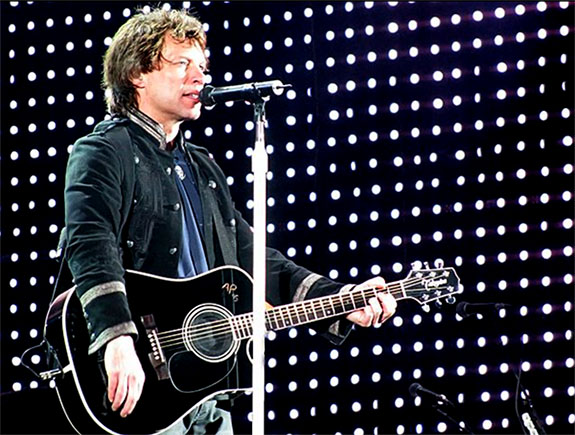
It’s called “Summertime” and includes this line… “I keep a postcard in the back of my mind / White sand, sunshine / And you shining like a brand new diamond.”
In the song, Jon Bon Jovi describes how his girlfriend reminds him of summertime. He reminisces about warm breezes, lazy days, beach blankets, a bottle of wine and his girlfriend sparkling like a precious stone.
“Like a first slow dance and a first long kiss,” he concludes, “there ain’t nothing, baby, better than this.”
Written by frontman Jon Bon Jovi, lead guitarist Richie Sambora and producer John Shanks, “Summertime” blended the best elements of rock and country music to create an upbeat, sing-along experience that had Bon Jovi fans dancing in the aisles. The song was featured on the Bon Jovi setlist from 2007 through 2011.
"Summertime" appeared as the second track from Lost Highway, Bon Jovi's 10th studio album. The group’s calculated maneuver into the country genre paid off big time as the album charted in 23 countries and made its debut at #1 on the US Billboard 200 Albums chart. It was the group’s first album to debut at #1 and was so well received that it went on to be nominated for Best Pop Vocal Album at the 2008 Grammy Awards.
John Francis Bongiovi, Jr., was born in Perth Amboy, NJ, in 1962. A blood relative of Frank Sinatra, the young Bon Jovi spent much of his youth skipping school to pursue musical activities. By the time he was 16, he was already playing in New Jersey clubs. A year later, while sweeping floors at his cousin Tony Bongiovi’s recording studio, Bon Jovi got the opportunity to sing on a Star Wars Christmas album. His first official credit was on a 1980 release called “R2-D2 We Wish You A Merry Christmas.”
By 1983, Bon Jovi had formed the group that bears his name. Over the past 39-plus years, the group has sold more than 120 million records and performed more than 2,700 concerts in 50 countries. Bon Jovi and Sambora were inducted into the Songwriters Hall of Fame in 2009.
We hope you enjoy the video of Bon Jovi’s live performance of “Summertime.” The lyrics are below if you’d like to sing along…
“Summertime”
Written by Richie Sambora, John Shanks and Jon Bon Jovi. Performed by Bon Jovi.
Feels something like summertime
Top down and nothin’ but time
Radio’s on and your by my side
Feels something like summertime
These days life goes like this
Wake up, check that off of some list
Gotta be a little something more than this
The bottom of my coffee cup
I keep a postcard in the back of my mind
White sand, sunshine
And you shining like a brand new diamond
It’s keeping me for giving up
Thinking like I had enough
You make me feel something like summertime
Top down ain’t nothing but time
Radio’s on and you’re by my side
Feels something like summertime
Like a first slow dance and a first long kiss
There ain’t nothing, baby, better then this
It’s like a beach blanket and a bottle of wine
It feels something like summertime
Summertime
I was a warm breeze with a cool tan
Life mapped out on the back of my hand
When I was laughing I was making plans
But I didn’t laugh when I found you
There's a heaven baby your the proof
You make me feel something like summertime
Top down ain’t nothing but time
Radio’s on and you’re by my side
Feels something like summertime
Like a first slow dance and a first long kiss
There ain’t nothing, baby, better than this
It’s like a beach blanket and a bottle of wine
It feels something like summertime
(Sum-summer-summertime)
Feel something like summertime
Top down ain’t nothing but time
Radio’s on for me and my valentine
It’s like that first slow dance and that first long kiss
There ain’t nothing baby better then this
It’s like a beach blanket and a bottle of wine (Yeah)
Feels something like summertime
Top down ain’t nothing but time
Radio’s on and you’re by my side,
Feels something like summertime
Just like summertime
(Sum-sum-summertime)
But it feels alright
Credit: Photo by Matthew Fox, CC BY 2.0, via Wikimedia Commons.
In the spirit of the ancient alchemists who spent countless hours attempting to transmute cheap metals into gold, scientists from Germany’s HZDR research lab recently turned ordinary plastic into diamonds. For real.
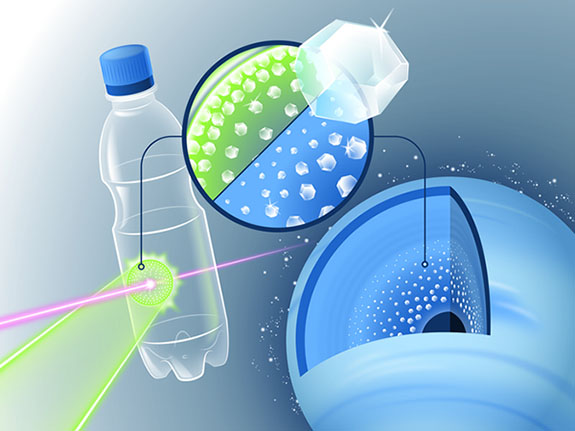
In the experiment, researchers blasted a thin sheet of plastic — the kind used to make plastic bottles — with powerful lasers, briefly heating the material to 6,000 degrees Celsius. The extreme heat, pressure and resulting shock wave compressed the plastic into tiny "nanodiamonds."
For a brief moment in the lab, scientists simulated the conditions in the interior of icy giant planets, such as Neptune and Uranus, where temperatures reach several thousand degrees Celsius and the pressure is millions of times greater than in the Earth’s atmosphere.
Ice giants not only contain carbon and hydrogen but also vast amounts of oxygen. When searching for suitable film material, the researchers hit on an everyday substance: PET, the resin out of which ordinary plastic bottles are made.
“The effect of the oxygen was to accelerate the splitting of the carbon and hydrogen and thus encourage the formation of nanodiamonds,” said Dominik Kraus, an author of the study, which was published in the journal Science Advances. “It meant the carbon atoms could combine more easily and form diamonds.”
The results of the experiment support the assumption that it literally rains diamonds inside the ice giants. The researchers noted that the findings are probably not just relevant to Uranus and Neptune, but to innumerable other planets in our galaxy, as well. While such ice giants used to be thought of as rarities, it now seems clear that they are probably the most common form of planet outside the solar system, they wrote.
The laser experiment also points to new methods for creating tiny diamonds to be used for industrial abrasives and polishing agents, quantum sensors and other applications.
“So far, diamonds of this kind have mainly been produced by detonating explosives,” Kraus explained. “With the help of laser flashes, they could be manufactured much more cleanly in the future.”
The team conducted its experiments at SLAC National Accelerator Laboratory in California, the location of the Linac Coherent Light Source (LCLS), a powerful, accelerator-based X-ray laser.
Credit: Image courtesy of HZDR / Blaurock.
Golden treasure unearthed during the kitchen renovation of an 18th-century townhouse is likely to yield a $290,000 payday for a UK couple in Ellerby, a village in North Yorkshire, about 50 miles north of Manchester.
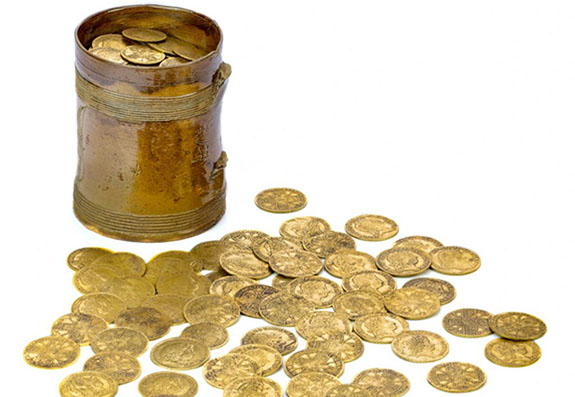
After ripping up the kitchen floor boards and breaking through a concrete slab, the couple encountered what they thought were old electrical connections. What they actually pulled out of the ground was an earthenware vessel about the size of a soda can filled to the brim with 264 gold coins. The container had rested undisturbed for nearly 300 years.
The well worn coins were dated from 1610 to 1727 and covered the reigns of James I through that of King George I. The gold coins carried face values between £50 and £100, but when they hit the auction block at Spink and Son in London on October 7 they will likely sell for more than a quarter million dollars.
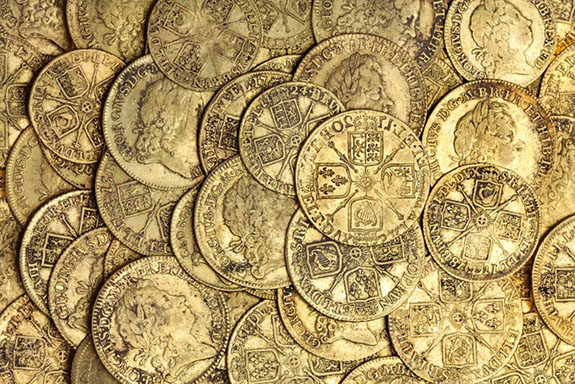
"It is a wonderful and truly unexpected discovery from so unassuming a find location," auctioneer Gregory Edmund said in the press release sent to CNN. "This find of over 260 coins is also one of the largest on archaeological record from Britain, and certainly for the 18th century period."
Spink and Son's research revealed that the "Ellerby Area Hoard," was likely accumulated by Joseph and Sarah Fernley-Maisters, who were married in 1694 and occupied the house until their deaths in 1725 and 1745, respectively. The couple was part of an influential family that traded in iron ore, timber and coal. Several family members served in the Parliament in the early 1700s.
Edmund added that the strategy of hiding gold under their kitchen floor likely reflected the couple's distrust of the newly formed Bank of England (1694) and the newfangled paper "banknote."
The auction house explained that the Fernley-Maisters family line dwindled soon after Sarah died at the age of 80, which is presumably why the coins were never retrieved.
According to artnet.com, the most unusual coins in the "Ellerby Area Hoard" include a 1720 George I guinea that reflects an embarrassing minting error. The coin has two "tails" sides. Another oddity is a 1675 Charles II guinea which misspells the King's Latin name as “CRAOLVS” instead of “CAROLVS.”
Credits: Photos courtesy of Spink and Son, London.
Sotheby's recently unveiled the 11.15-carat Williamson Pink Star, the second-largest internally flawless, fancy vivid pink diamond ever to appear at auction. The bubblegum pink, cushion-cut gem is expected to fetch upwards of $21 million when it headlines a single-lot auction scheduled for October 5 in Hong Kong.
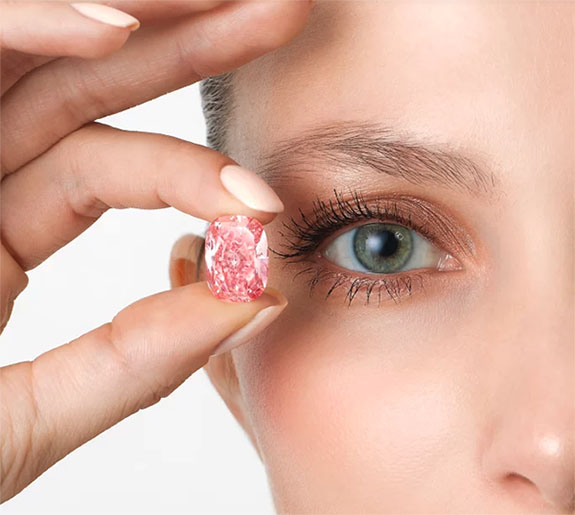
The Williamson Pink Star has the potential to set a new record for the highest price-per-carat ever paid for a fancy vivid pink diamond.
The finished stone was cut from a 32-carat rough diamond unearthed at the famous Williamson Mine in Tanzania. This is the same mine that produced the 23.6-carat "Williamson" pink diamond, which centers a Cartier-designed, flower-motif brooch worn at high-profile events by Queen Elizabeth II. The gem had been given to the Queen as a wedding gift in 1947 by Canadian geologist Dr. John Thorburn Williamson, who owned the mine.
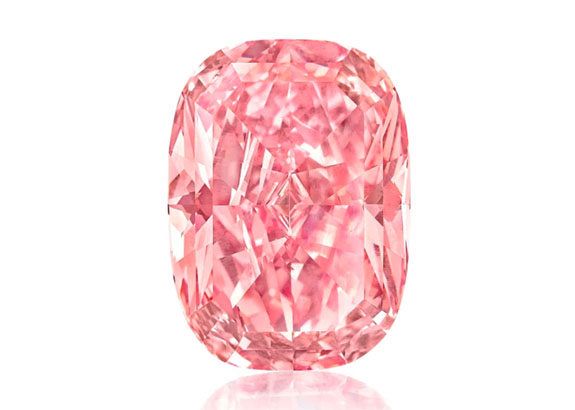
In fact, the name "Williamson Pink Star" is a nod to both the Williamson mine and the CTF Pink Star, a 59.60-carat record-breaking diamond sold at Sotheby’s in April 2017. The $71.2 million earned by the stone remains the highest price ever paid for any gem at auction.
Interestingly, Diacore is credited with cutting both the Williamson Pink Star and the CTF Pink Star.
The Gemological Institute of America classified the Williamson Pink Star as one of the rarest of all gemstones.
Noted the GIA, "Attaining a Fancy Vivid color grade with pink diamonds in this size requires a very strong inherent body color in the rough crystal. It is unusual for pink diamonds to occur with a strong depth of color or saturation in any size… In addition to its exceptional color, the clarity is Internally Flawless – a special combination. Examples such as this are some of the rarest gems ever discovered.”
Unlike yellow or blue diamonds that owe their color to the presence of nitrogen or boron in their chemical makeup, pink diamonds owe their color to the effects of intense pressure and heat while they were still deep within the Earth. These factors caused distortions in the diamond’s crystal lattice that influence the way the gem absorbs green light, thus reflecting a pink hue.
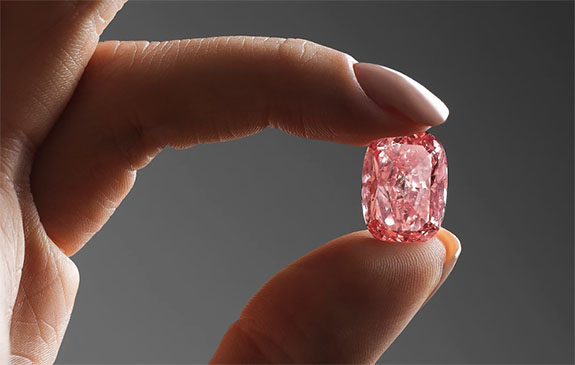
The Williamson Pink Star is currently on a world tour that began in London and includes stops in Dubai, Singapore, Taipei, Taichung and Hong Kong, where it will be offered for sale in a unique, single-lot auction.
Credits: Images courtesy of Sothebys.
Welcome to Music Friday when we bring you super songs with jewelry, gemstones or precious metals in the lyrics or title. Today we present British alternative rock band Coldplay performing “The Goldrush,” a nifty little 2009 tune teeming with references to gold mining, precious metals and a ring.
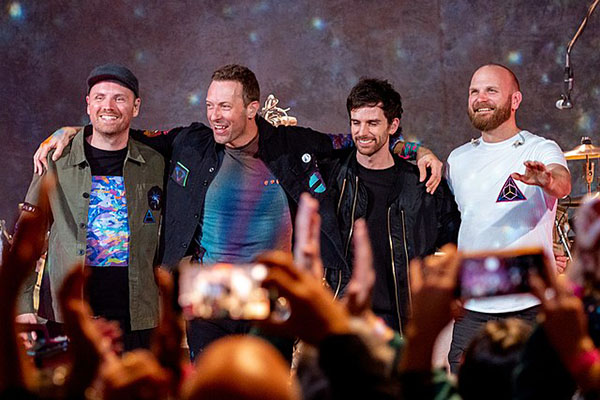
Reminiscent of the famously spontaneous Beatles studio sessions, “The Goldrush” spotlights drummer Will Champion taking over lead vocals as his bandmates can be heard chatting in the background before joining in the song. Champion sings, “I went digging for gold / I went down by the valley / Over by the mountain / Where the prospector had been told.”
Later in the song, we learn that the young treasure hunter has a girlfriend back home who's hoping to get engaged.
He sings, "There's a tiny little crackle on the telephone line / Saying what's the use of metal if the metal don't shine? / She said, 'Bring me back a ring 'cause I really want one' / Now I've been digging so long that I've never seen the sun."
“The Goldrush” had been written by the bandmates for Coldplay’s fourth studio album, Viva la Vida, but didn’t make the cut because is was so unlike the other songs in the album.
Then the band’s frontman, Chris Martin, floated the idea that “The Goldrush” could be offered exclusively to concert ticket holders. In this way, their most devoted fans would be the only ones to know the song. That idea never came to fruition.
Instead, “The Goldrush” ended up on the B-side of the Grammy-nominated “Life in Technicolor ii” single, which was released in 2009.
Formed by Martin in 1996 under the name Pectoralz, the band changed its name to Coldplay in 1998. Since its inception, the band has sold more than 100 million records worldwide and has earned numerous awards, including seven Grammys from 36 nominations. In 2022, the group's touring gross surpassed $1 billion from the sale of 12 million tickets at 456 shows.
Trivia: Did you know that Coldplay donates 10% of its profits to charity. The group currently endorses more than 30 organizations.
Please check out the audio clip of Coldplay performing “The Goldrush.” The lyrics are below if you'd like to sing along…
"The Goldrush"
Written by Chris Martin, Will Champion, Jonny Buckland and Guy Berryman. Performed by Coldplay.
I went digging for gold
I went down by the valley
Over by the mountain
Where the prospector had been told.
I'm marching through the cold
I'm marching through the cold.
I went digging for gold
I went down with my brother
A bucket and a shovel
With a book about the color of coal.
I'm marching through the cold
I'm marching through the cold.
There's a tiny little crackle on the telephone line
Saying what's the use of metal if the metal don't shine?
She said, "Bring me back a ring 'cause I really want one"
Now I've been digging so long that I've never seen the sun.
I went digging for gold
I went down to the valley
Over by the mountain
Where the prospector had been told.
I'm marching through the cold
I'm marching through the cold.
There's a tiny little crackle on the telephone line
Saying what's the use of metal if the metal don't shine?
She said, "Bring me back a ring 'cause I really want one"
Now I've been digging so long that I've never seen the sun.
I've been digging so long that I've never seen the sun
I've been digging so long that I've never seen the sun.
Credit: Photo by Raph_PH, CC BY 2.0, via Wikimedia Commons.
Sapphire is widely associated with delightful blue hues. But did you know that this gem variety of the mineral corundum and official birthstone for the month of September is also available in nearly every color of the rainbow?
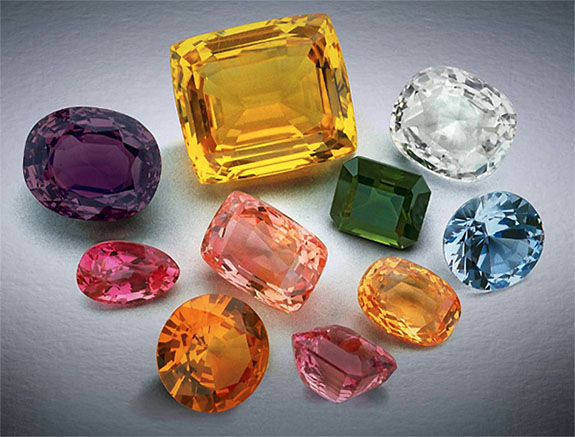
In its pure state, the corundum is colorless, but when trace elements are naturally introduced to the chemical composition, the results are magical and vibrant. Trace elements, such as iron, titanium, chromium, copper and magnesium, give naturally colorless corundum a tint of blue, yellow, purple, orange or green, respectively, according to the American Gem Society.
Corundum gems that are NOT red or blue are called fancy-colored sapphires. Blue corundum can take the simple designation of sapphire, while red corundum is classified as ruby.
The most rare of all the fancy-color sapphires is the "padparadscha," which presents a heavenly orange-pink hue reminiscent of a lotus blossom.
The fancy colored sapphires pictured above range in size from 10.3 to 92.6 carats. The green and large yellow sapphires are from Myanmar (formerly Burma) and the others were mined in Sri Lanka. All of these gems are part of the National Gem Collection at the Smithsonian's National Museum of Natural History in Washington, DC.
Corundum has a hardness of 9 on the Mohs scale, compared to a diamond, which has a hardness of 10.
In additional to being the official September birthstone, sapphire is also the preferred gem for couples celebrating their 5th or 45th wedding anniversaries.
Historically, the finest and most vibrant gem-quality sapphires have come from Sri Lanka, Myanmar and the Kashmir region of India. Significant sapphire deposits are also found in Australia, Afghanistan, Cambodia, Cameroon, China (Shandong), Colombia, Ethiopia, Kenya, Laos, Madagascar, Malawi, Mozambique, Nigeria, Rwanda, Tanzania, Thailand, United States (Montana) and Vietnam.
Credit: Image by Chip Clark / Smithsonian and digitally enhanced by SquareMoose.