
Eight ultra-rare, fancy blue diamonds ranging in size from 1.22 carats to 11.29 carats and collectively worth more than $70 million will headline Sotheby's Magnificent Jewels auctions in New York, Geneva and Hong Kong. Three of the stones will be offered for sale by the end of this year, and the rest will hit the auction block in early 2023.
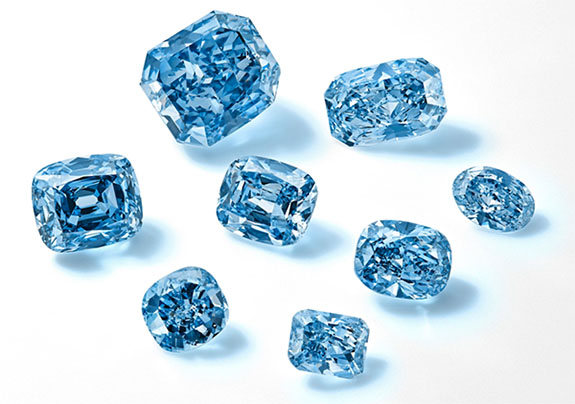
"The De Beers Exceptional Blue Collection" includes blue diamonds of various shapes and weights totaling 32.09 carats. The diamonds were sourced at the historic Cullinan mine in South Africa, the same mine that produced the De Beers Blue, a 15.10-carat step-cut, fancy vivid blue diamond that fetched $57.5 million at Sotheby's Hong Kong in April 2022.
In November 2020, De Beers and Diacore jointly purchased five rare blue rough diamonds from the Cullinan mine that weighed a total of 85.62 carats. Over a period of nearly two years, Diacore meticulously cut and polished the five roughs — ranging from 9.61 to 25.75 carats — and transformed them into the eight-piece collection you see, above.
Each of the polished gems share the name "De Beers Exceptional Blue" and is distinguished by a number that represents its carat weight.
For instance, the De Beers Exceptional Blue 5.53, with an estimated sale price of $11 to $15 million, will highlight Sotheby’s Magnificent and Noble Jewels auction in Geneva on November 9.
Both the De Beers Exceptional Blue 3.24 ($5 million to $8 million) and De Beers Exceptional Blue 2.08 ($1.2 million to $1.5 million) will be offered on December 7 at the Magnificent Jewels sale in New York.
The other five diamonds from the collection are slated to be sold during the Spring of 2023.
Four of the eight blue diamonds in the collection earned the color grade of "fancy vivid" from the Gemological Institute of America. Fancy vivid is the highest color grading for colored diamonds. The other four earned the grade of "fancy intense."
"Nearly six months after we set a new benchmark for one of the highest prices achieved for a blue diamond at auction with the $57.5 million sale of the De Beers Blue, we are honored to be entrusted with this superb collection of fancy blue diamonds," commented Quig Bruning, head of Sotheby’s Jewels, Americas. "Also recovered from the historic Cullinan mine in South Africa, the De Beers Exceptional Blues are a true testament of our world’s most extraordinary treasures and what is yet to be discovered."
Here's the full list of the diamonds of The De Beers Exceptional Blue Collection, from largest to smallest:
The De Beers Exceptional Blue Collection just embarked on an international publicity tour that starts in Hong Kong (October 17-19) and will move on to Singapore (October 20-21), Taipei (October 26-27) and Geneva (November 4-8).
Blue diamonds are considered one of the rarest colors of all diamonds. A fabulous fluke of nature, a blue diamond is produced by the random presence of the element boron within the diamond’s carbon structure.
Scientists believe that blue diamonds form about 400 miles below the surface, four times deeper than about 99 percent of all other diamonds.
Credit: Photo courtesy of De Beers.
Welcome to Music Friday when we feature awesome songs with jewelry, gemstones or precious metals in the lyrics or title. Today, a soulful Marvin Gaye compares his girlfriend's greatness to precious gems in his memorable hit from the late 1960s, “Too Busy Thinking About My Baby.”
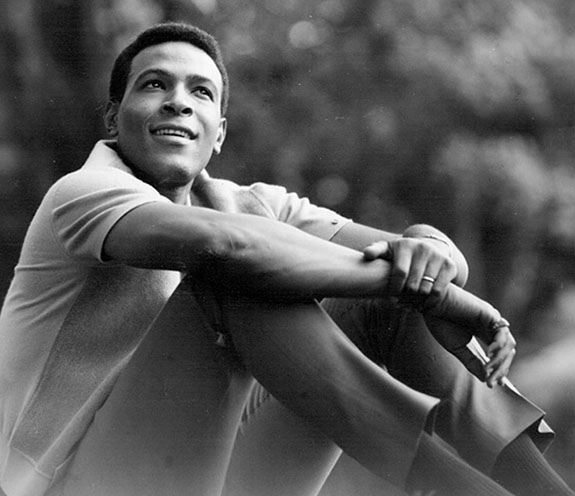
Gaye portrays a man who is so obsessed with the love of his life that he “ain’t got time for nothing else.” He sings, “The diamonds and pearls in the world / Could never match her worth, no no / She’s some kind of wonderful, people tell ya / I got heaven right here on earth.”
Written by Norman Whitfield, Barrett Strong and Janie Bradford, “Too Busy Thinking About My Baby” was first recorded by The Temptations in 1966, but attained huge commercial success when Gaye released his rendition three years later.
The song peaked at #4 on the Billboard Hot 100 chart, sold more than 1.5 million copies and was the top R&B single of 1969. “Too Busy Thinking About My Baby” became Gaye’s second biggest hit of the 1960s, trailing only his iconic “I Heard It Through the Grapevine” — another Whitfield/Strong collaboration — which ascended to #1 on the charts in 1968 and sold more than 4 million singles.
Born Marvin Pentz Gay Jr. in 1939, in Washington, DC, the singer co-founded a local doo-wop group, the Marquees, which later became the Moonglows. When the Moonglows’ tour arrived in Detroit, Motown executives noticed Gaye’s talent and signed him to a deal.
Proclaimed the Prince of Motown and Prince of Soul, Gaye enjoyed a stellar career that flourished throughout the 1960s, 1970s and early 1980s. Gaye’s life came to a tragic end on April 1, 1984, only one day before his 45th birthday. At the height of his success, Gaye was senselessly shot to death by his father after an argument.
Although he’s been gone for more than 38 years, Gaye’s music and influence lives on. After his death, he was inducted into the Rock and Roll Hall of Fame, Rhythm and Blues Music Hall of Fame, Songwriters Hall of Fame and was awarded a Grammy Lifetime Achievement Award.
We hope you enjoy the audio clip of Gaye performing “Too Busy Thinking About My Baby.” The lyrics are below if you’d like to sing along…
“Too Busy Thinking About My Baby”
Written by Norman Whitfield, Barrett Strong and Janie Bradford. Performed by Marvin Gaye.
Ah-ah-aaah, oh yeah… Oh listen to me people
I ain’t got time to think about money
Or what it can buy
And I ain’t got time to sit down and wonder
What makes a birdie fly
And I don’t have the time to think about
What makes a flower grow
And I’ve never given a second thought
To where the rivers flow
Too busy thinking about my baby
And I ain’t got time for nothing else
Said, I ain’t got time to discuss the weather
How long it’s gonna last
And I ain’t got time to do no studies
Once I get out of class
Tellin ya I’m just a fellow
Said I got a one track mind
And when it comes to thinking about anything but my baby
I just don’t have any time
Too busy thinking about my baby
And I ain’t got time for nothing else
Too busy thinking about my baby
And I ain’t got time for nothing else
The diamonds and pearls in the world
Could never match her worth, no no
She’s some kind of wonderful, people tell ya
I got heaven right here on Earth
I’m just a fellow
With a one, one track mind
And when it comes to thinkin’ about anything but my baby
I just don’t have any time
Too busy thinking about my baby
And I ain’t got time for nothing else
Too busy thinking about my baby
And I ain’t got time for nothing else
Too busy thinking about my baby
And I ain’t got time for nothing else
Credit: Photo by-J. Edward Bailey, Public domain, via Wikimedia Commons
Credit: photo by-J. Edward Bailey, Public domain, via Wikimedia Commons.
Exactly 731 gemstones weighing a total of 18.50 carats are artfully arranged in a breathtaking 14-karat white gold ring that tells the story of the Colorado Avalanche's franchise and the team's exciting march to the NHL 2022 Stanley Cup championship.

Designed by Jostens, each ring is set with 669 diamonds, 18 custom-cut genuine sapphires, two round genuine sapphires and 42 custom-cut genuine rubies.
The team's players, coaching staff and owners received their rings in a private ceremony just ahead of the season opener, which took place last night against the Chicago Blackhawks at Ball Arena in Denver.
“We wanted to bring the Avalanche’s championship journey to life, and this ring tells that story beautifully," said Chris Poitras, VP and COO of Jostens Professional Sports Division.
The ring is teeming with unique details that depict the team's championship journey.
The ring top features the distinctive Avalanche mountainous “A” logo and the title of STANLEY CUP CHAMPIONS in raised gold lettering above 18 custom-cut sapphires. Creating the "A" are six custom-cut rubies, symbolic of the exciting six-game Stanley Cup Final victory over the defending champion Tampa Bay Lightning.
Paying homage to Joe Sakic’s lifetime commitment to the Avalanche, as well as his distinction of being the only team captain and general manager to win a Stanley Cup with the same team, 19 diamonds are set in the snow that flows to the black hockey puck on the logo (Sakic's jersey number was 19). These diamonds have a total weight of .22 carats, a nod to the 22 years of Kroenke ownership.
An additional 220 diamonds are intricately set, cascading down the ring top. A design element from the team’s jersey is brought to life along the top and bottom edges of the ring top through custom-cut rubies set in the pattern of the “mountain” stripe detail found on their jersey. Thirty-six rubies are set in the stripes.
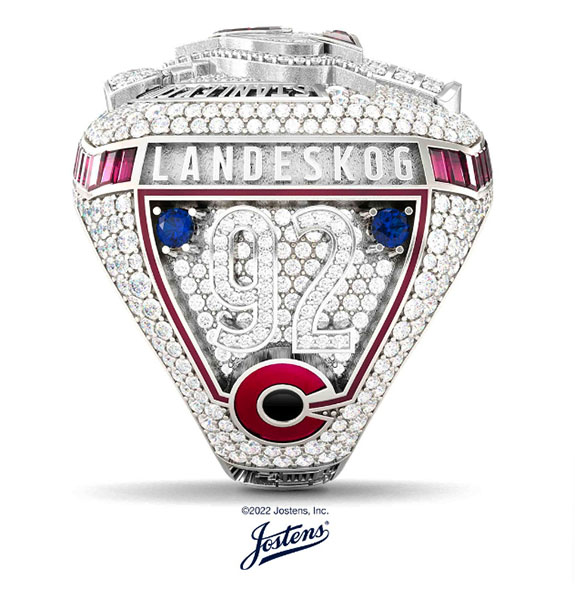
The left side of the ring features the player’s name in raised white gold. Below the name is the player's jersey number set in diamonds. Set on either side of the player’s number are two sapphires, symbolizing the team's ’96 and ’01 Stanley Cup victories. Completing the left side is a representation of the team's alternate "C" logo, which is seen on the shoulder of the team’s home jersey. The alternate logo is accented with black ceramic – a nod to the team's most recent Stanley Cup title. The background of the left side is a shimmering ground of 80 diamonds.
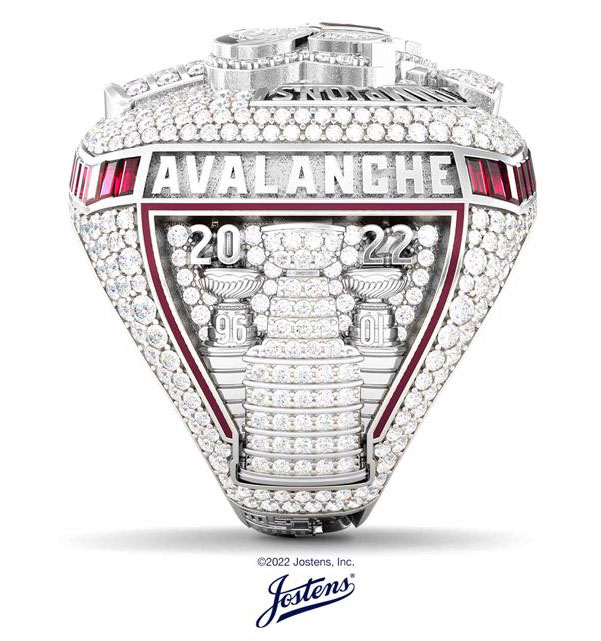
Displayed at the top of the right side of the ring is the team’s name created in the official Avalanche jersey font. Below are three Stanley Cups. The largest Cup in the center is set with 44 diamonds. The year-dates of each Stanley Cup title are proudly displayed on the Cups. The background of the right side is completed with 28 diamonds. In total there are 72 diamonds set on the right side. That number is significant because it represents the 72 combined regular season and playoff victories won by the Avalanche during the championship season. This accomplishment tied an NHL record that's been achieved only three times in the league’s 104-year history.

Flowing from the top of the ring, down the sides and wrapping around the palm are 184 diamonds. The exterior palmside of the ring includes a detailed miniature version of the iconic Denver skyline, a tribute to the team's home city.
The interior of the ring features the team motto “FIND A WAY” with the “A” represented by the Avalanche logo. Below are the series results from the Avalanche’s dominate playoff run. As a final detail, the date of the championship series game six, 6-26-22, can be found on the interior palmside of the ring.
Credits: Images courtesy of Jostens.
Despite some signs of a softening economy, US consumers are still in a spending mood as we hurtle toward the holiday season, according to the Mastercard SpendingPulse™. The credit card company's annual holiday forecast is predicting that US retail sales will increase 7.1% year over year, excluding automotive sales.

That's very good news, considering last year's holiday sales hit a record high.
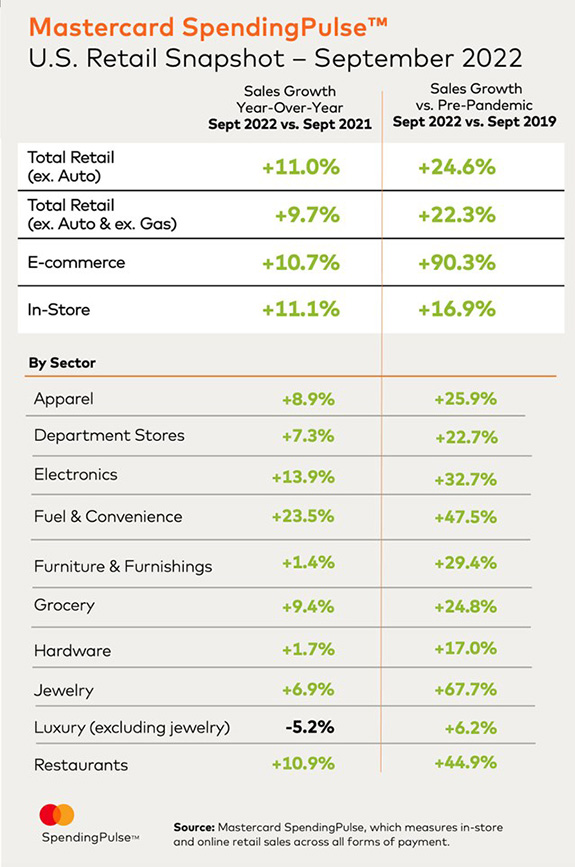
Retail jewelry sales showed no signs of slowing down in September 2022, as consumer spending jumped 6.9% compared to September of 2021 (YOY) and an impressive 67.7% versus the pre-pandemic figures of September of 2019 (YO3Y).
"This holiday season, consumers may find themselves looking for ways to navigate the inflationary environment – from searching for deals to making trade-offs that allow for extra room in their gift-giving budgets," noted Michelle Meyer, US Chief Economist at the Mastercard Economics Institute. "New job creation, rising wages and lingering savings should have many consumers ready and able to spend."
Experiential spending continues to rein in consumers’ dollars, according to the survey, as reflected in these sectors showing strong September 2022 YOY gains: Airlines (56.4%), Lodging (38.1%) and Restaurants (+10.9%).
These numbers reflect pent-up demand from consumers, who were forced to hunker down during the prolonged effects of the global pandemic. A shift in consumer spending reflects a need for normalcy, the survey noted.
Overall US retail sales (excluding automotive) increased 11% in September 2022 compared to September 2021, and 24.6% compared to September 2019. The month's in-store sales picked up 11.1% YOY and e-commerce sales increased 10.7% over that same period.
Consumers' widespread acceptance of spending online is reflected in the e-commerce YO3Y sales increase of 90.3%.
Mastercard SpendingPulse™ findings are based on aggregate sales activity in the Mastercard payments network, coupled with survey-based estimates for certain other payment forms, such as cash and check.
Credits: Shopper image by Bigstockphoto.com. Table courtesy of Mastercard SpendingPulse™.
The finest black opals come from Lightning Ridge, an Aussie mining area that has been yielding top-quality opals since 1903 — about the same time Louis Comfort Tiffany took his first stab at designing fine jewelry at the age of 54.
Tiffany, whose father was Charles Lewis Tiffany, the founder of the famous jewelry company, was already a household name based on his magnificent stained glass, ceramics and metalwork. When the elder Tiffany passed away in 1902, his son was determined to embrace a new discipline.
According to the The Metropolitan Museum of Art, Louis Tiffany's earliest jewelry designs were exhibited at the 1904 Louisiana Purchase Exposition in St. Louis, where they earned favorable reviews from the art critics of the period. Tiffany's naturalistic designs, use of semiprecious stones with enamel and meticulous handcraftsmanship elevated his imaginative jewelry to the status of art.

Tiffany was particularly fond of opals, according to the Smithsonian, and used them extensively in his work. Louis often sought the advice and expertise of George Frederick Kunz, the gem expert at Tiffany & Company, who traveled the world in search of unusual gems and semi-precious stones for the company’s designers.
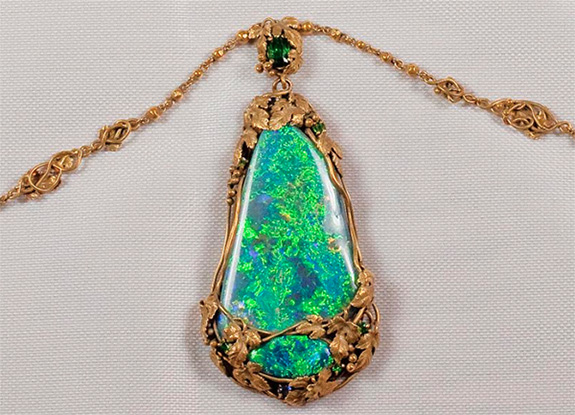
Louis designed the black opal necklace, shown above, later in his career. The Art Nouveau necklace is 30-inches in length and features two black opals — a large one on top and a smaller one at the bottom — secured in a vine of 18-karat gold grape leaves and accented with brilliant-cut green demantoid garnets.
Donated to the Smithsonian in 1974 by Mrs. F. R. Downs Jr. and Mrs. R. O. Abbott Jr., the unique piece was originally purchased from Tiffany's on New Year's Eve 1929, according to the original sales receipt. It is currently part of the National Gem Collection at the National Museum of Natural History in Washington, DC, and an excellent example of October's official birthstone. The other October birthstone is tourmaline.
Precious opals are universally loved because they can present all the colors of the rainbow. Each opal is truly unique and more than 95% of the world’s fine opals are sourced in Australia. Other varieties include white opals, boulder opals, crystal opals and fire opals.
Scientists believe that between 100 million and 97 million years ago, Australia’s vast inland sea, which was populated by marine dinosaurs, began retreating. As the sea regressed, a rare episode of acidic weather was taking place, exposing pyrite minerals and releasing sulphuric acid. As the surface of the basin dried further and cracked, silica-rich gel became trapped in the veins of the rock. Over time, the silica solidified to form opals.
In precious opal, the silica spheres are uniform in size and are stacked into an orderly arrangement, which gives the structure the ability to break visible white light into separate colors.
Interestingly, 95% of the opals found by miners is void of color. These specimens are white, grey or black. The locals call it “potch” and it has very little value. Potch is composed of the exact same mineral as fine opal – spheres of silica dioxide. The only difference is that in potch, the tiny silica spheres are jumbled, whereas in precious opal they’re all laid out evenly.
The value of a fine opal is based on a number of factors, including brightness, color, pattern, body tone and consistency (how it looks from multiple angles).
Credits: Images by Ken Larsen / Smithsonian.
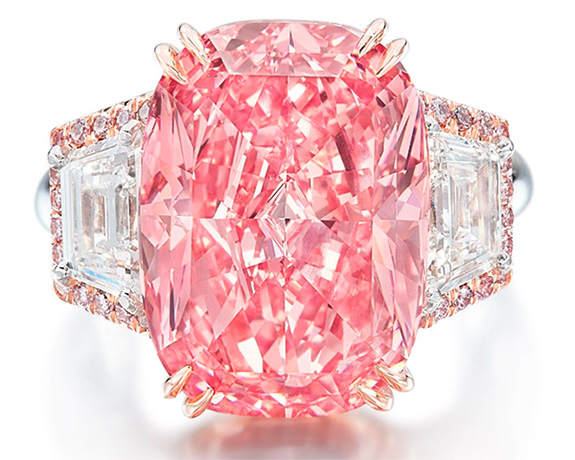
The 11.15-carat Williamson Pink Star lived up to its pre-sale hype at Sotheby's Hong Kong on Friday when — after a tense, 20-minute bidding war — the second-largest internally flawless, fancy vivid pink diamond ever to appear at auction sold for the staggering price of $57.7 million. That was more than 2.5 times the auction house's high estimate of $21 million.
The winning bid submitted via phone by a collector in Boca Raton, FL, stands as the second highest price ever paid for any gem at auction. Only the 59.60-carat CTF Pink Star sold for more at $71.2 million (Sotheby's Hong Kong, 2017).
The Williamson Pink Star also crushed the record for the highest price-per-carat ever paid for any gemstone at auction. At $5.2 million per-carat, the gem soundly overtook the $3.9 million per carat achieved by the 14.62-carat Oppenheimer Blue at Christie's Geneva in 2016.
The bubblegum pink, cushion-cut gem (shown, above, mounted on an 18-karat ring and flanked by trapeze-cut diamonds) was cut from a 32-carat rough diamond unearthed at the famous Williamson Mine in Tanzania.
This is the same mine that produced the 23.6-carat “Williamson” pink diamond, which centers a Cartier-designed, flower-motif brooch often worn at high-profile events by the late Queen Elizabeth II. The gem had been given to the Queen as a wedding gift in 1947 by Canadian geologist Dr. John Thorburn Williamson, who owned the mine.
In fact, the name “Williamson Pink Star” is a nod to both the Williamson mine and the CTF Pink Star.
Just after Friday's single-lot sale in Hong Kong, the anonymous winning bidder renamed the stone “The Rosenberg Williamson Pink Star.” The Rosenberg part of the gem's name and the owner's location of Boca Raton, FL, offer clues to who the new owner could be. We assume that person will come forward shortly.
Market watchers believe that the strength of the pink-diamond segment is partly attributed to the closure of Rio Tinto’s Argyle Mine in Australia, which famously produced between 90% and 95% of the world’s pink and red diamonds during its 37 years of production. The mine officially ceased operations on November 3, 2020.
Unlike yellow or blue diamonds that owe their color to the presence of nitrogen or boron in their chemical makeup, pink diamonds owe their color to the effects of intense pressure and heat while they were still deep within the Earth. These factors caused distortions in the diamond’s crystal lattice that influence the way the gem absorbs green light, thus reflecting a pink hue.
Credits: Images courtesy of Sothebys.
Welcome to Music Friday when we often bring you classic songs with jewelry, gemstones or precious metals in the title or lyrics. Today, the incomparable Carole King gets the ring in her classic 1964 hit, “Oh No Not My Baby.”

King assumes the role of a young woman, whose trust is unwavering despite signs that her boyfriend has been fooling around. She sings, “When my friends told me you had someone new / I didn’t believe a single word was true.”
Later in the song, King rationalizes that even if he was unfaithful, the dalliance was hardly a betrayal. She sings, “Well, you might have had a last-minute fling / But I am sure it didn’t mean a thing / ‘Cause yesterday you gave me your ring.”
Co-written by King and then-husband Gerry Goffin, “Oh No Not My Baby” was originally recorded in 1964 by Maxine Brown and subsequently covered by some of the biggest names in the music business, including Aretha Franklin, Cher, Rod Stewart, Linda Ronstadt, the Shirelles, Manfred Mann, Dusty Springfield, Debby Boone, Julie Budd, Eydie Gormé and the made-for-TV band The Partridge Family.
Although Carole King has composed most of her songs for other performers, many fans agree that nobody does Carole King like Carole King. That’s why we chose to feature King’s rendition of “Oh No Not My Baby,” which appeared on her 1980 album Pearls: Songs of Goffin and King as well as her 2001 album Love Makes the World.
Born Carol Joan Klein to a New York City firefighter dad and teacher mom, King started playing the piano at the age of 4. While attending high school she dated singer-songwriter Neil Sedaka and changed her name to Carole King. She and her buddy Paul Simon (Yes, of Simon & Garfunkel fame) earned extra money by making demo records for $25 per session. While attending Queens College, she met Goffin, who became her song-writing partner. They were married one year later, in 1959, when King was only 17 years old. The marriage lasted nine years.
In the early 1970s, King launched a successful solo career catapulted by the immense success of Tapestry, a breakthrough album that topped the U.S. album charts for 15 weeks in 1971 and remained on the charts for more than six years. It sold 30 million copies worldwide and still stands as one of the bestselling albums of all time.
King is credited with writing or co-writing 118 songs that have appeared on the Billboard Hot 100. King was inducted into the Rock and Roll Hall of Fame twice, as a writer in 1990 and as a performer in 2021. King announced her retirement in 2012, but then walked back that statement in 2013, clarifying that she was just “taking a break.” She is still performing at the age of 80.
Please check out the audio track of King’s awesome rendition of “Oh No Not My Baby.” The lyrics are below if you’d like to sing along.
“Oh No Not My Baby”
Written by Carole King and Gerry Goffin. Performed by Carole King.
When my friends told me you had someone new
I didn’t believe a single word was true
I showed them all I had a faith in you
I just kept on saying
Oh, no, not my baby
Oh, no, not my sweet baby
You’re not like those other guys
Who lead you on and tell you lies
My mama told me when rumors spread
There’s truth somewhere and I should use my head
But I didn’t listen to what she said
I kept right on saying
Oh, no, not my baby
Oh, no, not my sweet baby
You’re not like those other boys
Who play with hearts like they were toys
Well, you might have had a last-minute fling
But I am sure it didn’t mean a thing
‘Cause yesterday you gave me your ring
And I’m so glad that I kept on saying
Oh, no, not my baby
Oh, no, not my sweet baby
You’re not like those other guys
Who lead you on and tell you lies
Oh, no, not my baby
Oh, no, not my sweet baby
Oh, no, not my baby
Oh, no, not my sweet baby
Credit: Image by Angela George, CC BY-SA 3.0, via Wikimedia Commons.
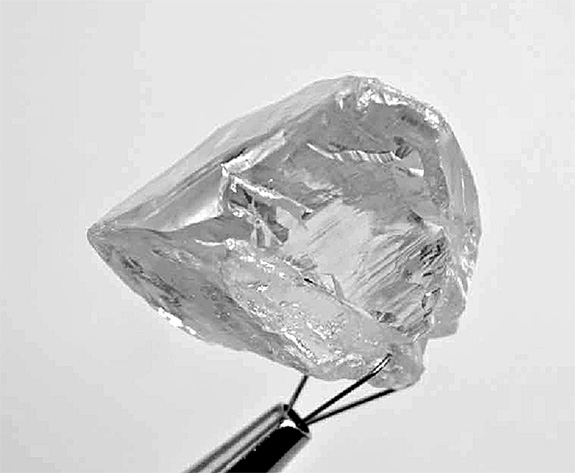
Lucapa Diamond Company celebrated another milestone when it unveiled a 113-carat, gem-quality, white, Type IIa diamond from its flagship Lulo site in Angola. It was the fifth 100-plus-carat diamond recovered in 2022 and the 30th 100-plus-carat stone unearthed since the site was opened in 2015.
The Lulo mining area, which comprises 1,100 square miles along the length of the 31-mile Cacuilo River, has generated a steady flow of high-quality, impressive finds.
So far, the diamonds recovered at Lulo have been of the alluvial variety, which means that they ferried from their original source by ancient rivers.
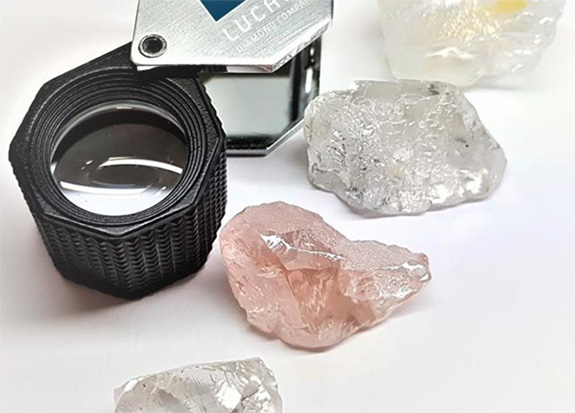
Back in May of 2019, Lucapa's chairman, Miles Kennedy, told stockholders that "huge wealth" was within reach because his exploration team was closer than ever to striking the mother lode at Lulo. That meant locating the primary source of the diamonds that ended up downstream.
“There are no silver bullets in the kimberlite exploration game,” Kennedy said at the time. “But the patient and methodical approach adopted by our exploration team is narrowing down and confining the search areas of our quest. It may take us another couple of years, but I am more confident than ever that we can indeed find the diamond source at Lulo.”
Earlier this year, the company reported that it had discovered 24 new kimberlites at Lulo, bringing the total number to 133. Kimberlite exploration is conducted by the Lulo partners through the separate Projecto Lulo joint venture. This exploration is designed to locate the hard-rock primary sources of the exceptional Lulo alluvial diamonds.
“The Lulo alluvial mine continues to produce diamonds of great size and quality," said Lucapa managing director Stephen Wetherall. "With the stand-alone kimberlite bulk sampling plant now in operation and processing the priority kimberlite samples, we are working hard to realize the primary source kimberlite potential on the Lulo concession.”
The company's success in recovering extremely large stones has been credited largely to the installation of a $3.5 million state-of-the-art XRT large-diamond recovery system in 2017. The system uses advanced X-ray transmission technology (XRT) and larger screens (55mm) so diamonds up to 1,100 carats can be cherry picked. XRT technology is also more efficient at recovering low-luminescing, ultra-pure Type IIa diamonds.
Lucapa has a 40% stake in the Lulo mine and holds an exploration license that runs until April 2023. The mining firm maintains two partners in the project — Empresa Nacional de Diamantes EP and Rosas & Petales.
The Australia-based mining company also holds a 70% stake in the Mothae mine in Lesotho, which commenced commercial production in 2019.
Credits: Rough diamond images courtesy of Lucapa Diamond Company.
Scientists at Washington State University (WSU) were stunned when platinum outperformed gold in a test to determine how much pressure they could take.
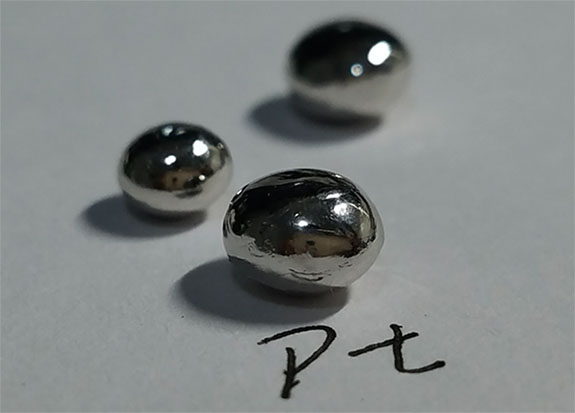
Prior to the study, the scientists at WSU's Institute for Shock Physics speculated that gold would be the victor, but the final results weren't even close.
Platinum easily held its atomic structure at 3.5 million atmospheres, the pressure at the center of Earth. Then the researchers pushed platinum even further, and the metal continued to hold its structure to nearly 4 million atmospheres, at which point it reached 3,215 degrees Fahrenheit and began to melt.
On the other hand, the researchers were surprised when gold's structural integrity began to fail at a relatively modest 1.5 million atmospheres.
“Science is all about curiosity,” said Yogendra Gupta, director of the Institute for Shock Physics at WSU. “Even though I had 48 years of experience in this field, and I was certain gold would behave as I suspected, I was just wrong. That is why we do experiments in science.”
In the test, scientists used a powerful laser to subject four types of metals to immense pressure over short intervals of about 10 to 15 billionths of a second. They then used a synchrotron to send x‑ray pulses into the materials to study the changes in their physical structure.
“Basically, we can look inside things and provide information about their atomic structure,” Gupta said. “This is the only synchrotron-based facility in the US capable of doing these kinds of experiments.”
Silver and copper were also put to the test. Surprisingly, silver matched gold's performance, while copper lasted a little longer before transforming at 1.7 million atmospheres of pressure.
One atmosphere of pressure is what an average person will experience at sea level. At a depth of 5,000 meters (about 3 miles), the pressure will be approximately 500 atmospheres or 500 times greater than the pressure at sea level.
“It’s really just pure fun science more than anything, but nevertheless I find it fascinating,” Gupta said. “I kind of laugh about it because you will never produce 1.5 million atmospheres of pressure in any real-world scenario. For all practical purposes gold is stable.”
Platinum's superior performance at WSU's Institute for Shock Physics aligns neatly with the messaging on the website of the trade organization Platinum Guild International (PGI).
Writes the PGI, "It takes a lot to say 'forever,' but when you’re selecting bridal jewelry—or any jewelry, for that matter—it’s important to know that platinum is truly eternal. This noble metal, one of the strongest, natural materials on the planet, is also one of the longest lasting."
And now we've learned that platinum also performs best under pressure.
Credit: Image by 2x910, CC BY-SA 4.0, via Wikimedia Commons.
There’s an ancient Egyptian legend that describes how tourmalines got their amazing colors, and it goes something like this... On their long voyage up to the surface from the center of the Earth, tourmalines passed through a rainbow — and by doing so, assumed all of its colors.

The name “tourmaline” is derived from the Singhalese words “tura mali,” which mean “stone with mixed colors.” In fact, when it comes to color, tourmaline is the undisputed champion of the gemstone world.
Not only does tourmaline come in a wide range of colors, such as blue, red, green, yellow, orange, brown, pink, purple, gray and black, the official October gemstone also boasts bi-color and tri-color varieties. (The other official birthstone for October is opal.)
One of our multicolor favorites is called “watermelon tourmaline” because it features green, white and pink bands that look very much like a slice of the delicious summer fruit. Designers love to use thin, polished cross-sections of watermelon tourmaline in their work. Gem collectors love watermelon tourmaline because it’s fun and so unusual.
According to the American Gem Society, the multicolor gems with the clearest color distinctions are the most highly prized.
The trade has unusual names for the wide variety of multicolor tourmalines. According to the International Colored Gemstone Association, colorless crystals with black on both ends is called “Mohrenkopf,” a chocolate-coated marshmallow treat sold in the German-speaking part of Switzerland.
Tourmaline crystals that have banded color zones that lie on top of one another are referred to by the Brazilians as “papageios” or “rainbow tourmaline.” A tourmaline with red on one end is called a “Turk’s head tourmaline.” Apparently, the reference is a nod to the red fez cap made popular in Turkish culture.
Tourmaline is found in many locations around the world, including the U.S. (mainly California and Maine), Brazil, Afghanistan and East Africa.
Tourmalines get their color from trace elements that are introduced to a gem’s chemical structure. Lithium-rich tourmalines yield blue, green, red, yellow and pink colors, while iron-rich tourmalines are black to bluish-black. Magnesium-infused tourmalines tend to be brown-to-yellow in color. Multicolored crystals reflect a “fluid chemistry” during crystallization.
Credit: Photo via Wikimedia Commons, CC BY-SA 3.0.
