
Japanese scientists are on a mission to save the species of oyster responsible for producing the world's most beautiful cultured pearls. The Japanese pearl oyster — Pinctada fucata — is fighting for its survival as viruses and red tides have taken a savage toll on oyster populations and, as a result, pearl production in Japan has shrunk by 70% over the past 20 years.
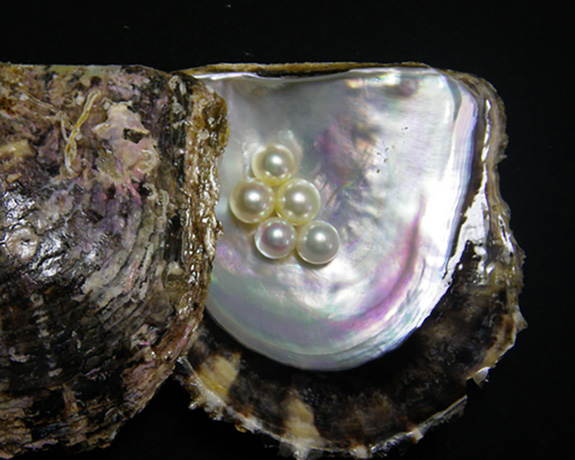
In an effort to preserve the future of the Japanese pearl industry, scientists have constructed a high-quality, chromosome-scale genome of the Pinctada fucata species, which they hope can be used to breed hardier, more resilient mollusks. The research was published recently in DNA Research.
“It’s very important to establish the genome,” said Dr. Takeshi Takeuchi, staff scientist in the Okinawa Institute of Science and Technology (OIST) Marine Genomics Unit. “Genomes are the full set of an organism’s genes — many of which are essential for survival. With the complete gene sequence, we can do many experiments and answer questions around immunity and how the pearls form.”
Scientists at the OIST, in collaboration with K. Mikimoto & Co.'s Pearl Research Institute and the Japan Fisheries Research and Education Agency, reconstructed 14 pairs of chromosomes (28 in total) and found key differences between the two chromosomes of one pair—chromosome pair 9. Notably, many of these genes were related to immunity.
“Different genes on a pair of chromosomes is a significant find because the proteins can recognize different types of infectious diseases,” said Dr. Takeuchi.
The scientists believe that the current state of the pearl farming industry is due partly to the lack of genetic diversity in the oyster population. Pearl farmers often breed oysters that have a higher rate or survival or ones that produce more beautiful pearls. But, researchers observed that after three consecutive inbreeding cycles, the genetic diversity was significantly reduced. Genetic deterioration due to the inbreeding of oysters with superior traits makes it difficult for the species to respond to various environmental changes and the emergence of pathogens.
“It is important to maintain the genome diversity in aquaculture populations,” concluded Dr. Takeuchi.
Akoya pearl production is currently 20,000kg (44,092 lbs) per year, down from 70,000kg (154,323 lbs) per year two decades ago. The scientists are hoping to restore an aquaculture industry that was generating 88 billion yen ($630 million) in annual revenue in the early 1990s. Despite diminished numbers, cultured pearls still rank as Japan's second-most-exported marine product, after scallops.
Credit: Image courtesy of K. MIKIMOTO & CO., LTD, Pearl Research Institute.
In a wonderful example of serendipity, Jessica and Seth Erickson of Chatfield, MN, mined their own 10th anniversary diamond at Arkansas’s Crater of Diamonds State Park.
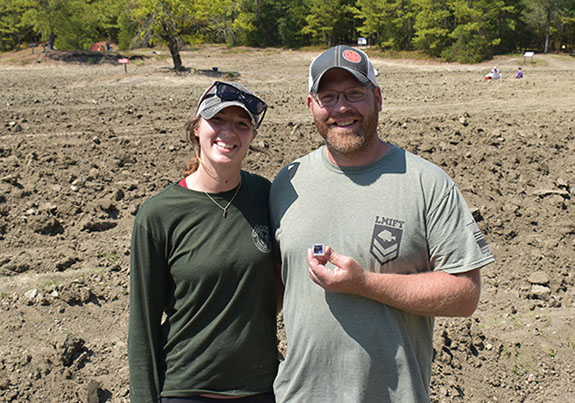
The couple had recently embarked on an 11-state road trip to celebrate their anniversary milestone and was excited to schedule a stop at the only diamond site in the world that’s open to the general public. The 37½-acre search field at the Murfreesboro park is actually the exposed eroded surface of an ancient diamond-bearing kimberlite pipe and amateur miners get to keep what they find.
The Ericksons arrived at Crater of Diamonds early on a Friday morning and spent the first few hours of their visit collecting material in the north section of the search field. By 11 a.m. they were wet sifting at the North Washing Pavilion with the assistance of some knowledgeable park regulars.
The regulars offered the Minnesota couple tips on how to properly sift their material using two screens — one with a quarter-inch mesh and the second with a 1/16th-inch mesh. The two-stage sifting process washes away the fine dirt and allows the smaller gravel to fall through the first screen and into the second.
According to park staff, about three-fourths of all diamonds registered at the Crater of Diamonds are found by wet sifting.
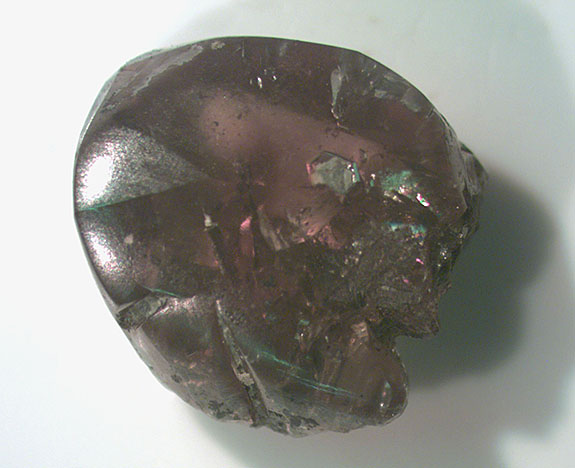
Although most diamonds are found after flipping gravel from the second screen onto a flat surface, Seth first spotted a metallic-looking gem in the bottom of the first screen. He knew right away it was a diamond and excitedly showed Jessica. Diamond, of course, is the official 10th anniversary gemstone.
According to park officials, it is very unusual to catch a diamond in the top screen of a screen set. The mesh size of the top screen is typically used to catch and remove bigger pieces of gravel – not diamonds. The average diamond size found wet sifting is a quarter of a carat. Typically, larger diamonds are found by surface searching.
The Ericksons placed their tea-color gem in a clear vial and walked it to the park’s Diamond Discovery Center, where park staff registered it as a 1.90-carat brown diamond about the size of a pony bead, a glass or plastic bead often used in children's crafts.
Many people who find diamonds at Crater of Diamonds State Park choose to name their gems. The Ericksons called their gem "HIMO," derived from the initials of each of their children.
So far this year, 581 diamonds have been registered at Crater of Diamonds State Park. An average of one to two diamonds are found by park visitors each day. Since the Crater of Diamonds opened as an Arkansas State Park in 1972, visitors have found more than 33,000 diamonds.
Credits: Photos courtesy of Crater of Diamonds State Park.
Welcome to Music Friday when we often bring you uplifting songs with jewelry, gemstones or precious metals in the title or lyrics. Today, Canadian recording artist Kelita performs “Tears,” an inspirational song about inner healing and overcoming adversity.

In this song, Kelita compares herself to a sparrow with broken wings. But, instead of accepting her fate of never being able to “fly,” she describes how the Holy One will take away the pain by cradling her teardrops in His hand and transforming them into precious stones.
She sings, “Shimmering diamonds, rubies of red / Bright as the blood that my dear Savior shed / Emeralds of green, sapphires of blue / He’ll take away your teardrops / Turn them into jewels.”
“Tears” first appeared in 2000 on Kelita’s Naked Soul album, a work that earned her a nomination for a Juno Award (Canada’s version of a Grammy) for Best Gospel Album. Kelita also included the song as the final track of her Heart of a Woman album in 2010.
Born Kelita Haverland in Alberta, Canada, the singer/songwriter/actress/comedian draws her strength from having overcome a series of seemingly insurmountable life challenges. As a child, she suffered physical abuse at the hands of a sibling. Her alcoholic father committed suicide and then her mother died from cancer. Her abusive sibling later died from a heroin overdose, and Kelita nearly lost her own life in a terrible auto accident.
Kelita’s official website explains that the artist writes, sings and speaks what is gleaned from her own life experiences. From a relentless life of tragedy to triumph, the lessons are shared with a transparency and honesty that engages, encourages and inspires. Her ability to touch and penetrate the hearts of audiences is what drives her success.
Kelita helped launch the career of an aspiring 19-year-old singer name Eilleen (Shania) Twain. The teenager from Timmins, Ontario, sang backup on Kelita’s hit song, “Too Hot to Handle.” Twain has gone on to become one of the best-selling artists of all time with more than 100 million records sold worldwide.
Please check out the audio clip of Kelita singing “Tears.” The lyrics are below if you’d like to sing along…
“Tears”
Written and performed by Kelita Haverland.
Tiny little sparrow fell from the tree
Sometimes I feel that little wounded sparrow is me
Tiny broken wings that never will fly
I wonder does her little heart know how to cry
Does her heart know how to cry
Are her tears gently falling inside
Crying tears she’s been trying to hide
Does her heart know how to cry like mine
Warm velvet words poured like sweet honey from his tongue
Until tonight I’d never heard the Holy one
He said that he would cradle every teardrop in His hand
He’d take away the pain and turn them into precious gems
Jesus knows the tears that you’ve cried
And he has seen them falling inside
Crying tears you’ve been trying to hide
Jesus knows the tears that you’ve cried like mine
Shimmering diamonds, rubies of red
Bright as the blood that my dear Savior shed
Emeralds of green, sapphires of blue
He’ll take away your teardrops
Turn them into jewels
Jesus knows the tears that you’ve cried
And he has seen them falling inside
Crying tears you’ve been trying to hide
Jesus knows, Jesus knows,
Jesus knows the tears that you’ve cried like mine
Credit: Promotional image via kelita.com.
A private Asian collector is the proud new owner of the 18.18-carat "Fortune Pink" diamond after placing the winning bid of 24.5 million Swiss francs ($24.6 million) at Christie's Geneva on Tuesday. With the buyer's premium, the final price for the stone touted as the largest pear-shaped "fancy vivid pink" diamond ever to appear at auction rose to $28.4 million Swiss francs ($28.5 million).
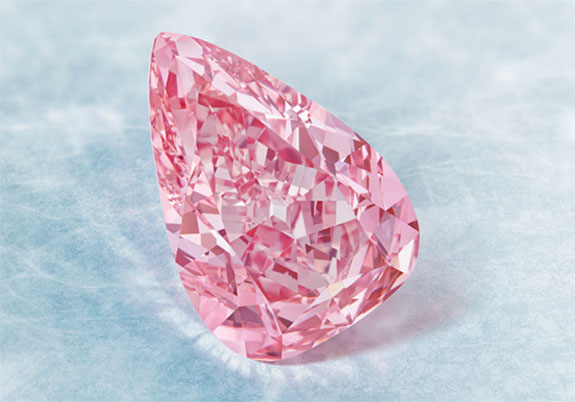
With a capacity crowd on hand to witness the excitement at the Hotel des Bergues in Geneva, bidding started at 17 million Swiss francs and continued to escalate for four tense minutes. Three telephone bidders vied to capture the diamond whose 18.18-carat weight carat promised to bring prosperity to the owner because the pairing of "18s" literally translates to “get rich for sure” in Chinese.
The unnamed Asian collector finally broke free from the pack by hiking his final offer by 500,000 Swiss francs.
The final price of $28.5 million ($1.57 million per carat) was in the lower range of the Christie's presale estimate of $25 million and $35 million.
The Christie's official who had been communicating the winner's bids via the telephone told AFP that the Asian collector described the successful purchase of the Fortune Pink as a "dream come true."
Max Fawcett, head of Christie's jewelry department in Geneva, told CBS News that the Brazilian-sourced Fortune Pink is a "truly incredible diamond" and a "true miracle of nature."
The extreme rarity of an 18-carat pink diamond of this quality is amplified by the fact that fewer than 10% of pink diamonds weigh more than 1/5 of a carat, according to the Gemological Institute of America. What’s more, only 4% of pink diamonds possess a color saturated enough to qualify as “fancy vivid.” Pink diamonds fall under the rare Type IIa category of diamonds, which make up less than 2% of all gem diamonds.
The largest fancy vivid pink diamond ever sold at Christie’s was the rectangular-cut, 18.96-carat “Winston Pink Legacy,” which achieved $50.37 million and set a world record price-per-carat for a pink diamond at auction ($2.65 million).
“The Pink Star” still holds the record for the highest price paid at auction for a pink diamond. That 59.6-carat, flawless, fancy vivid pink diamond fetched $71.2 million at Sotheby’s Hong Kong in 2017. It was purchased by Hong Kong luxury jeweler Chow Tai Fook and renamed the “CTF Pink Star.” Not only did it set a record in the pink category, but also shattered the world record for the highest price ever paid for any gem at auction.
Pink diamonds have become increasingly rare since the 2020 closure of Australia’s Argyle Mine, which had been the source of 90% of the world’s pink diamonds.
Credit: Image courtesy of Christie’s.
The sunny yellow November birthstone you see here is the world’s largest faceted citrine — an oval-cut, 20,200-carat marvel that vanished from the public eye in 2012.
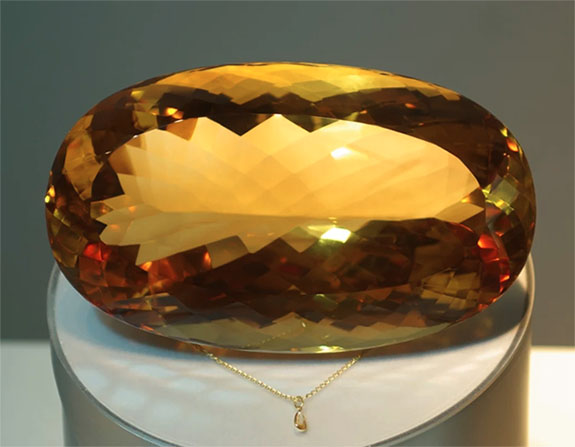
Named for what was once its host city, the “Malaga” had been selected as one of the “Special Exhibition Gems” of the Programa Royal Collections. It was 2010, and the curated collection of 24 world-class gems was expected to attract huge crowds to the Art Natura Malaga, a natural science museum on Spain’s Costa del Sol.
The mammoth rough citrine crystal that would be transformed into the Malaga was unearthed in Mina Gerais, Brazil, in 1990. Due to the risks, complexity and special equipment required to cut and polish the stone, it remained in its original form for 19 years. Finally, in 2009, a team of Brazilian gem cutters took on the formidable challenge of shaping the stone — with startlingly beautiful results.
Rarely does nature present a citrine crystal that could yield such a large faceted stone. Typically, citrine crystals are found in geodes and measure just a few centimeters in size. When they are found in larger formations, the quality is usually lacking and those specimens are used as decorative items.
The internally flawless Malaga citrine measured 20 x 15 x 10 centimeters (7.87 x 5.90 x 3.93 inches) and was set to take up permanent residency at Art Natura alongside other extraordinary citrines, including the previous record holder, the oval-cut, 8,200-carat “Sol del Sur” (Southern Sun) and the 6,705-carat, emerald-cut “Soledade” (Solitude).
Art Natura boasted one of the world’s largest collections of museum-quality gemstones. In all, the collection comprised more than 500,000 carats, and each gem represented the best in its class in terms of size, purity and color.
All the excitement surrounding the opening of Art Natura Malaga came to a screeching halt during the fall of 2012, when legal disputes between the museum's owners and the Malaga City Council forced the complex to close.
Art Natura Malaga continues to have a website and a Facebook page, but both properties seem to be stuck in November of 2012. Sadly, the internet hasn't provided any clues as to the whereabouts of the Malaga citrine or its supersized citrine cousins. In the meantime, we'll just have to relish that special time a decade ago when the Malaga citrine was a rock star.
Credit: Courtesy photo by Programa Royal Collections, 2010.
Despite economic headwinds, holiday season spending is expected to shatter previous records. The National Retail Federation (NRF) is predicting that retail sales during November and December 2022 will grow between 6% and 8% compared to 2021. That translates into consumer purchases that could top $960 billion, and easily outpace the $889.3 billion record-breaking tally of 2021, when sales grew 13.5% compared to the year before.

Historically, holiday retail sales have averaged an increase of 4.9% over the past 10 years.
“This holiday season cycle is anything but typical,” NRF Chief Economist Jack Kleinhenz said. “NRF’s holiday forecast takes a number of factors into consideration, but the overall outlook is generally positive as consumer fundamentals continue to support economic activity. Despite record levels of inflation, rising interest rates and low levels of confidence, consumers have been steadfast in their spending and remain in the driver’s seat.”
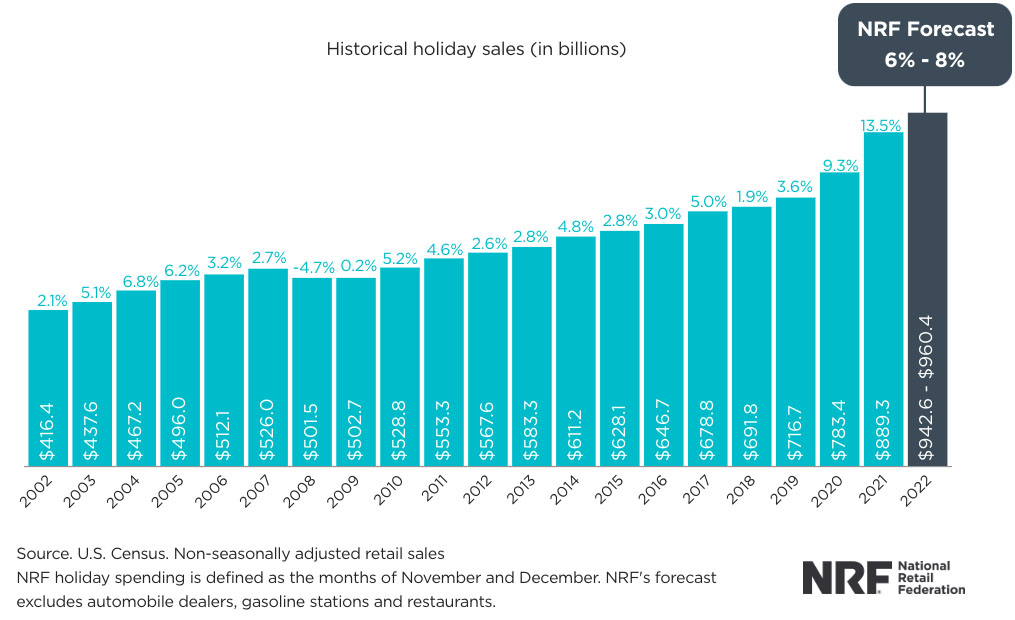
NRF noted that while ecommerce will remain important, households are expected to shift back to in-store shopping and a more traditional holiday shopping experience.
Online and other non-store sales are predicted to increase between 10% and 12% to between $262.8 billion and $267.6 billion. This figure is up from $238.9 billion in 2021, which saw extraordinary growth in digital channels as consumers turned to online shopping to meet their holiday needs during the pandemic.
“The holiday shopping season kicked off earlier this year – a growing trend in recent years – as shoppers are concerned about inflation and availability of products,” Kleinhenz said. “Retailers are responding to that demand, as we saw several major scheduled buying events in October. While this may result in some sales being pulled forward, we expect to see continued deals and promotions throughout the remaining months.”
Kleinhenz’ comments mirror NRF’s consumer data, which shows that consumers have been kicking off their holiday shopping early over the last decade in order to spread out their budgets and avoid the stress of holiday shopping.
NRF’s holiday forecast is in line with the organization’s full year forecast for retail sales, which predicted retail sales will grow between 6% and 8% to more than $4.86 trillion in 2022.
NRF's holiday forecast is based on economic modeling that considers a variety of indicators including employment, wages, consumer confidence, disposable income, consumer credit, previous retail sales and weather. NRF’s calculation excludes automobile dealers, gasoline stations and restaurants to focus on core retail. NRF defines the holiday season as November 1 through December 31.
Credits: Image by BigStockPhoto.com. Chart by National Retail Federation.
The Kafubu Cluster, a colossal 187,775-carat matrix of individual and intertwined emerald crystals, is expected to set a Gemfields' price record at the mining company's rough tender in mid-November.
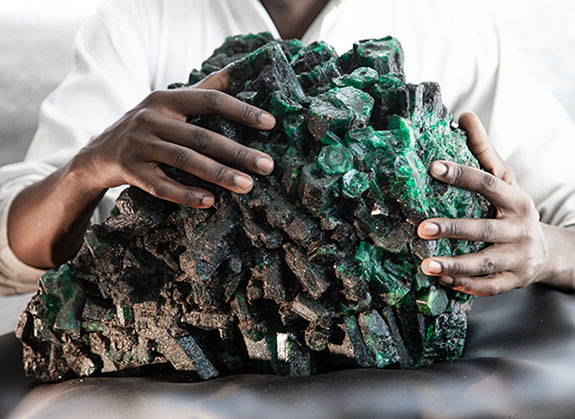
The impressive, 82.8-pound specimen was extracted in March 2020 from the Chama pit of the famous Kagem emerald mine in Zambia. Kagem is believed to be the world’s most prolific emerald mine.
“Rarity is one of the factors that makes emeralds hold such a special value in many cultures around the world, but the combination of this crystal cluster formation, the overall quality and the sheer enormity of the Kafubu Cluster is something I never thought possible,” commented Jackson Mtonga, Kagem's assistant sort house manager.
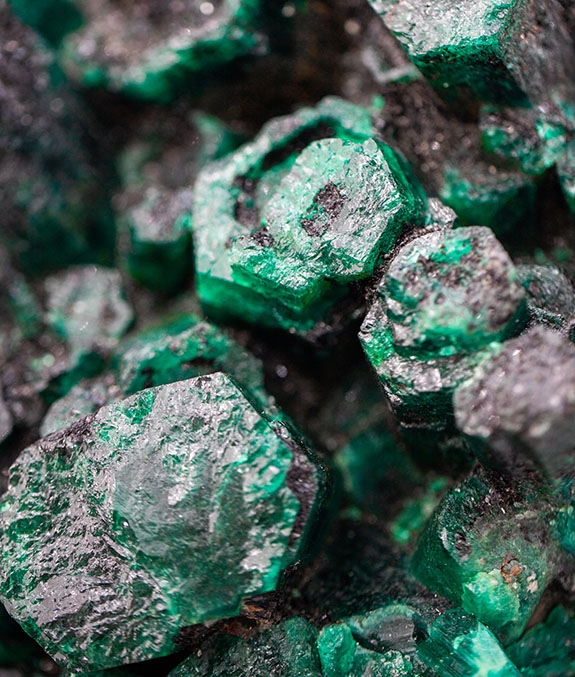
What's unique about the formation is that it's made up almost entirely of hexagonal emerald crystals. Hardly any other minerals are present.
According to the mining company, the Kafubu Cluster displays all the desired characteristics that an emerald should possess, including a vivid green color that glows and shines. The cluster also presents various levels of crystallization that will allow a cutter to create a collection of gems, ranging from fine-quality faceting material to cabochons and beads for everyday fun.
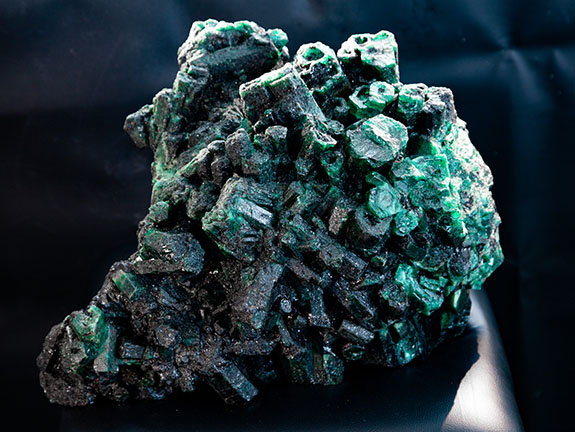
Gemfields believes the Kafubu Cluster could be transformed into tens of thousands of carats of commercial-to-fine-quality cut emeralds. There is also a possibility that the winning bidder will choose to preserve it in its natural form.
The Kafubu Cluster owes its name to the Kafubu river, which forms the natural southwest boundary of the Kagem property. Gemfields noted that the name Kafubu honors the unique landscape in which the colossal cluster was formed.
Gemfields, which owns 75% of the Kagem mine in a partnership with the Zambian government, noted that emeralds from Kagem tend to have a higher iron content than emeralds from other origins. This means they are less fragile and have fewer surface-reaching fractures.
Given its size and quality, it is likely that the Kafubu Cluster will be the most expensive single emerald piece ever sold by Gemfields. Viewing of the spectacular piece began last week at Gemfields' London headquarters. Bidding is set to close on November 17.
Credits: The Kafubu Cluster images courtesy of Gemfields.
Welcome to Music Friday when we bring you great throwback songs with jewelry, gemstones or precious metals in the title or lyrics. In today’s selection, John Lennon of The Beatles performs the lead vocals to “Anna,” the third track of the legendary group’s 1963 debut studio album, Please Please Me.

In the song, Lennon woefully accepts the fact that his girlfriend is in love with another man. He also insists on the return of the shining symbol of his affection, singing, “Anna, just one more thing girl / You give back your ring to me / And I will set you free / Go with him.”
Written and originally recorded by Arthur Alexander, “Anna” was a favorite of Lennon, who recommended that The Beatles cover it for Please Please Me.
When Alexander released his version 60 years ago in September 1962, it peaked on the Billboard chart at a modest #68. Less than a year later, it would be included on one of the most famous albums of all time — a work that would launch the careers of The Fab Four.
The album Please Please Me was released in the UK in March 1963 and in the U.S. in January of 1964 by Vee-Jay Records under the name Introducing… The Beatles.
Interestingly, the U.S. version stalled for nine weeks at #2 on the Billboard album chart. The #1 album during the same period was Meet The Beatles on Capitol Records.
Music critics noted that Lennon’s raspy vocals on “Anna” reflected a “tortured pain.” One explanation is that Lennon had a terrible cold during the historic session of February 1, 1963, when The Beatles recorded 11 songs in 10 hours.
Another oddity about the song is its subtitle (Go to Him). The lyrics of both Alexander’s and The Beatles’ versions clearly state, “Go with him.”
The Beatles went on to become the best-selling band in history, with 177 million certified records in the US and 600 million records worldwide. In 2004 and again in 2011, the group topped Rolling Stone magazine's list of the Greatest Artists in History.
The two surviving Beatles are Paul McCartney (80) and Ringo Starr (82). John Lennon was shot and killed by an obsessed fan in New York City in 1980. He was 41. George Harrison died of lung cancer in 2001 at the age of 58.
We invite you to enjoy the audio track of Lennon and The Beatles performing “Anna.” As a bonus, we've also included Alexander's original version. The lyrics are below if you’d like to sing along.
“Anna (Go to Him)”
Written by Arthur Alexander. Performed by The Beatles.
Anna, you come and ask me girl
To set you free, girl
You say he loves you more than me
So I will set you free
Go with him
(Anna)
Go with him
(Anna)
Anna, girl, before you go now
I want you to know now
That I still love you so
But if he loves you more
Go with him
All of my life I’ve been searching for a girl
To love me like I love you
Oh, now
But every girl I’ve ever had
Breaks my heart and leaves me sad
What am I, what am I supposed to do?
Oh, oh, oh, oh, oh, oh
Anna, just one more thing girl
You give back your ring to me
And I will set you free
Go with him
All of my lifeI’ve been searching for a girl
To love me like I love you
But let me tell you now
But every girl I’ve ever had
Breaks my heart and leaves me sad
What am I, what am I supposed to do?
Oh, oh, oh, oh, oh, oh
Anna, just one more thing girl
You give back your ring to me
And I will set you free
Go with him
(Anna)
Go with him
(Anna)
You can go with him girl
(Anna)
Go with him
Beatles Version 1963
Arthur Alexander Original Version 1962
Credit: The Beatles with Ed Sullivan by CBS Television, Public domain, via Wikimedia Commons.
Four hundred years ago, a galleon named Nuestra Señora de Atocha was making a return trip to Spain from the New World when it was hit by a squall and sank along the reefs near the Florida Keys.

This was no ordinary ship. It was packed to the rafters with treasures collected from Bolivia, Mexico, Colombia, Venezuela, the Caribbean and the Andes. The bounty included 24 tons of silver ingots, 180,000 silver coins, 125 gold bars and discs, 70 pounds of emeralds and a cache of precious natural pearls.
Lost for 363 years, the ship was finally discovered by treasure hunter Mel Fisher with the assistance of some high-profile benefactors, such as chicken magnate Frank Perdue. Fisher and his team would eventually recover artifacts with an estimated value of more than $1 billion, and Perdue was awarded a portion of the spoils, most of which he donated to Delaware Tech and the Smithsonian.
One item that he kept was a rough emerald that he would have cut into a 6.25-carat finished stone and mounted in an engagement ring for the love of his life, Mitzi. He proposed with the octagonal-shaped, step-cut gem in 1988.
The homespun chicken entrepreneur — who coined the phrase, "It takes a tough man to make a tender chicken" — passed away in 2005 at the age of 84.
On December 7, author and philanthropist Mitzi Perdue's 400-year-old historic emerald will hit the auction block at Sotheby’s Magnificent Jewels Sale in New York, with all proceeds going to benefit humanitarian efforts in Ukraine. The auction house has set a high estimate at $70,000, but due to the gem's provenance and charitable nature of the offering, it could sell for much more.
According to Artnet News, Mitzi was inspired to support Ukraine after visiting the country this past summer.
“I fell in love with the brave Ukrainian people and left with the deepest desire to do whatever I could to support the war-torn country,” said the human rights activist, who also happens to be the heiress to the Sheraton Hotels fortune (her dad co-founded the chain).
Mitzi told Fox News Digital, "When I was a child, my father told me, ‘The greatest pleasure my money has ever given me is in giving it away.’ I took those words to heart and he became a role model for me for the rest of my life."
The 81-year-old philanthropist holds degrees from Harvard University and George Washington University, is a past president of the 40,000 member American Agri-Women and was one of the U.S. Delegates to the United Nations Conference on Women in Nairobi.
She was a syndicated columnist for 22 years and authored more than 1,800 newspaper and magazine articles on family businesses, food, agriculture, the environment, philanthropy, biotechnology, genetic engineering and women’s health.
Her historic emerald ring will be on public display starting November 30 at Sotheby's in New York City.
Credit: Image courtesy of Sotheby's.
For more than 130 years, the sunken steamer known as the Ship of Gold, rested undisturbed in the Atlantic Ocean 7,200 feet beneath the surface, about 200 miles off the coast of South Carolina.

The side-wheeler, also known as the SS Central America, met its watery demise in 1857 when it got torn up by a hurricane while transporting precious cargo from Panama to Philadelphia via New York City. Onboard were 30,000 pounds of Gold Rush-era treasure and 578 passengers.
Only 153 people survived the disaster and all the cargo was lost. Headlines across the country declared the sinking of the 280-foot SS Central America as the country’s worst peacetime disaster at sea. The loss of the gold cargo was a major factor in the economically devastating financial Panic of 1857 in the United States.
The long-lost ship was back in the news in 1988 when an inventor named Tommy Thompson spearheaded a recovery operation, which involved sending down to the ocean floor a remotely operated vehicle named Nemo. Recovery from the shipwreck site occurred in several stages between 1988-1991 and again in 2014, according to Fred Holabird, president of Holabird Western Americana Collections.
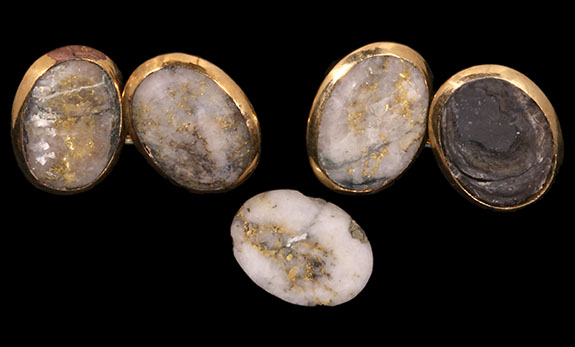
Artifacts from the site included dozens of 1850s gold rings, stickpins, cufflinks, a gold belt buckle, and several recovered pocket watch cases and covers. Some of the recovered rings have heart shapes waiting to be engraved with lovers’ initials once they reached their destination. California gold quartz items, such as cufflinks and brooches, were also found.

“Much of the gold jewelry was part of a commercial shipment, either carried by one of the jewelers on board or by a separate shipment transported on the voyage going to New York," explained Holabird. "Gold nugget stickpins were found still attached to their original thick paper boards, ready for resale on the New York or eastern seaboard jewelry market.”
On December 3, 2022, selected artifacts from the Ship of Gold will highlight a public auction at the Reno Convention Center in Nevada. Bidding will also take place online at www.HolabirdAmericana.com.
A second auction of hundreds of additional artifacts retrieved from the famous shipwreck will be offered in February 2023 (Exact dates to be announced).
“Many collectors have been waiting for these extraordinary items to come on the market since the legendary SS Central America was located in 1988 and Life magazine proclaimed it America’s greatest treasure ever found,” said Holabird.
According to a press release, insurance claims for the loss were paid in the 1850s, and the company that discovered and retrieved the treasure starting in 1988 settled with the insurers and their successors in 1992. With court approval, California Gold Marketing Group acquired clear title to all of that remaining treasure in 1999 as well as all the items recovered in 2014.
Credits: Images courtesy of Holabird Western Americana Collections.