
A former investment banker-turned-scientist is trying to revive Hong Kong's once-thriving pearl farming industry by merging traditional methods with RFID tracking technology.
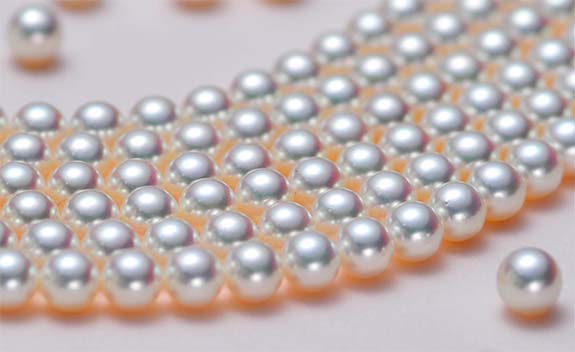
For more than 1,000 years, natural pearl farming had been a vital part of Hong Kong's culture. Colonists called Hong Kong the "Pearl of the Orient."
Eventually, overfishing in the waters off southern China made it impossible for natural pearl farmers to earn a living. In the 1950s, Hong Kong pearl farmers made a valiant, but unsuccessful, attempt to compete with their powerful Japanese counterparts in the cultured pearl trade. The region's last pearl farmers called it quits in 1981.
But now, a 58-year-old scientist named Yan Wa-tat is convinced that Hong Kong's pearl industry can make a comeback. A few years ago, Yan abandoned his career in Hong Kong's banking sector to try something “more interesting and also more productive for our society,” he told the Hong Kong Free Press.
He pursued a PhD at Hong Kong University’s School of Biological Sciences and began looking at ways to introduce RFID technology into the pearl cultivation process. Radio-frequency identification (RFID) chips are commonly used to track and identify objects, from automobiles to livestock. More recently, miniaturized RFID chips had been affixed to live ants in order to study their behavior.
Yan found that tiny RFID chips could be inserted into the bead that serves as the nucleus of a cultured pearl. The benefits, Yan explained, are twofold.
First, it's common for 10% to 20% of bead nuclei to be expelled by the oyster. Normally, farmers wouldn't know if the oyster contained a cultured pearl until it was opened during the harvesting process. Now, farmers can get a definitive answer with a simple swipe of a smartphone-based RFID reader.
Second, the RFID chip is a surefire way to confirm the origin of a cultured pearl, reducing the risk of misidentification or fraud.
Currently, only 10% of Hong Kong's 1,000 fishing rafts are in use. The rafts typically hold baskets of nucleated oysters that are regularly pulled from the water to be cleaned of barnacles and other parasites. There is plenty of unused raft capacity, but many young entrepreneurs are hesitant to join the fishing trade, according to Yan.
This past March, a small group of local pearl farmers inspired by Yan showed off their first harvest of Akoya cultured pearls. Based on that success, Yan is hoping that others will be convinced that cultured pearl production in Hong Kong can be viable and profitable.
“If I can show to the fishermen that they can make a living, diversify their income sources, then I think they will be interested in doing this,” Yan told the Hong Kong Free Press.
Credit: Photo by MASAYUKI KATO [CC BY-SA 3.0], via Wikimedia Commons.
Here's a super-fun product for gemstone lovers looking to stay cool this summer. The "Koji Ring Popsicle Mold" allows you to create frosty faceted confections from your favorite fruit juice, yogurt, smoothie, pudding or even chocolate.

Imagine how much a youngster would enjoy a Koji Ring glistening with a super-sized purple "amethyst" made from grape juice or a vivid "yellow diamond" that tastes so much like a mango smoothie. And for those of us who are young at heart, how about a green tea-flavored frozen "peridot" or a hazelnut coffee "topaz." The possibilities are as vast as one's imagination.

The wearable pops are the frosty cousin of the popular Ring Pop, a jewel-shaped candy ring that has been employed by more than one future groom as a temporary stand-in for an actual engagement ring.
The "Koji Ring Popsicle Mold" kit, which has a list price of US$14.99, comes with a mold base, eight Jewel Pops in four unique shapes, and eight "ring" handles with drip guards.
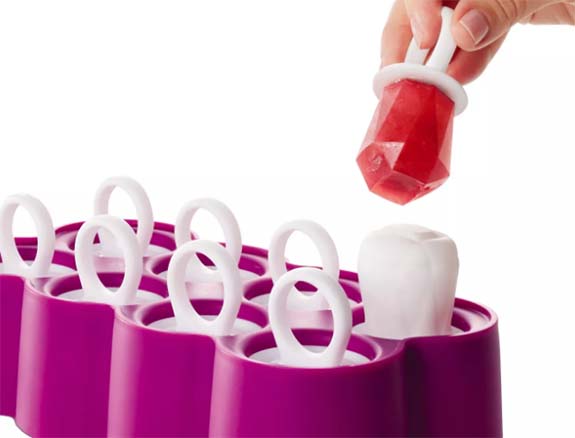
Each frozen pop can be easily removed by simply pulling on the ring. The silicone mold inverts and then "pop" — the frozen treat releases from the mold. The kit is currently on sale at Target.com for US$9.99.
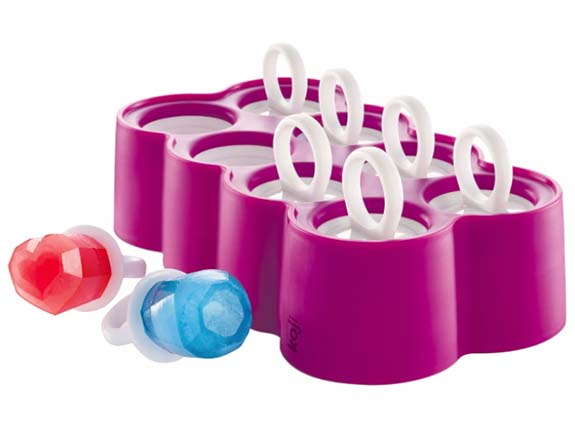
This fun product has been racking up an impressive number of five-star reviews.
Wrote one satisfied grandmother, "I bought this for my daughter and grandchildren. They love them. Easy to make healthy fruit popsicles for the kids. We try all different healthy varieties and flavors. The ring pop concept is so cute and is the reason I actually purchased them. As a child, my daughter loved on special occasions getting a Ring Pop treat. Now, instead of the Ring Pop being a sugary snack, she makes a delicious, healthful treat. Also the pops remove easily from the form. We love these!!!"
The Koji product also seem to be a hit with new moms challenged with teething tots.
Wrote Jollymommy: "This is perfect for baby!! I was looking for a way to make homemade pops for baby, but most molds are too big! When I saw this it looked perfect. It works for babies and for kids, because they look just like Ring Pops! The pop comes out easily after being frozen, and clean up is super easy. I was so happy to get this, especially at the price!
Credits: Images via Target/Koji.
The massive 1,758-carat diamond recovered in April at the Karowe mine in Botswana will soon have a name thanks to a competition hosted by Lucara Diamond Corp.

The mining company is promising a $3,000 cash prize and a tour of the mine to the Botswana citizen who comes up with the best name for a grey-black gem that has the distinction of being the second-largest diamond ever discovered. Only the 3,106-carat Cullinan, found in South Africa in 1905, was larger.
The name must be in Setswana, the national language of Botswana, according to the official rules. Entrants must state why they chose that particular name, the meaning of the name and what the chosen name signifies. The competition runs through June 14. The winner will be honored at a gala dinner, where the grand prize will be presented.

This is not the first time Lucara has hosted a naming competition. In 2016, after the discovery of a 1,109-carat gem-quality white diamond at the same Karowe mine, Lucara execs offered a similar reward.
Thembani Moitlhobogi won 25,000 Pula (about $2,215) after five judges picked his recommended name, “Lesedi La Rona,” which means “Our Light” in Setswana, from more than 11,000 entries.
“Lesedi La Rona symbolizes the pride and history of the people of Botswana,” Lucara CEO William Lamb said at the time. “The outpouring of pride and patriotism shown by all the participants in the contest was incredible.”
Prior to the naming of Lesedi La Rona, Lucara had called on Botswana's school children to help rename it AK6 mine. "Karowe," which means "precious stone" in the local language, was picked as the winning entry and the victorious students earned computers for their school.
The star of Lucara's current naming competition is the size of a tennis ball and weighs about 12.4 ounces. The stone is being characterized as “near” gem quality with “domains of high-quality white gem.” Lucara has yet to estimate its value.
Credits: Images courtesy of Lucara Diamonds.
Nearly six months after winning the 5,655-carat "Inkalamu" emerald at a Gemfields auction last November, luxury jeweler Diacolor finally revealed the Zambian-sourced crystal to the public last week at the company's flagship store in Delhi, India.
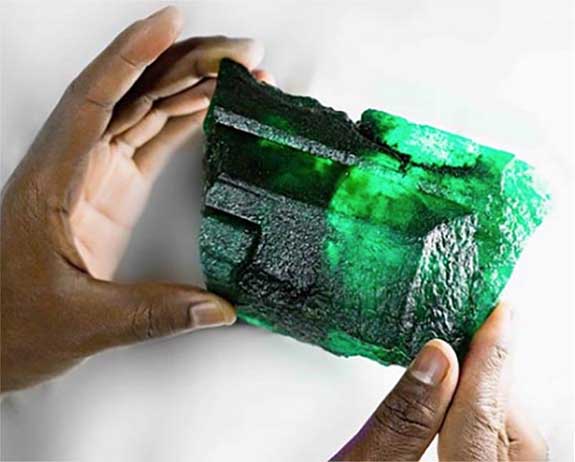
Inkalamu, which means the “Lion Emerald” in Zambia's regional Bemba language, was discovered at the Kagem mine on October 2 and offered for sale in Singapore in mid-November. There, 45 approved auction partners competed for the extraordinary find — an emerald that boasts remarkable clarity and a perfectly balanced golden green hue. The carat weight is equivalent to 1.1 kg or 2.5 lbs.

“The minute I heard about it, I simply had to have it,” Diacolor's founder and chairman Rajkumar Tongya told The Economic Times. “Such a rare find from Mother Nature, I just couldn’t resist the temptation.”
The founder's son, Rishabh, who is Diacolor's creative director, told the India-based publication that he got goosebumps when he first laid eyes on the “kryptonite-type” emerald.
Neither Diacolor nor Gemfields have revealed the amount of the winning bid.
Despite its massive size, Inkalamu is not the largest crystal to be unearthed at the Kagem mine. In 2010, it yielded a 6,225-carat emerald named “Insofu,” the Bemba word for “elephant.”
And it's not a coincidence that the father-son team at Diacolor purchased that rough gem, as well.
Rajkumar Tongya hinted to The Economic Times that Inkalamu might yield a "pear-shaped, uniform-looking jewelry set."
A Gemfields representative said in October that Inkalamu will take its place among the world’s most exceptional gemstones of all time, and if the crystal is divided into smaller stones, the “The Pride of Inkalamu,” so to speak, will continue the legacy for generations to come.
Before Diacolor takes on the task of cutting and polishing the mammoth stone, the company will be promoting it during an international tour of retail outlets and museums.
The name Inkalamu honors the work carried out by two of Gemfields’ conservation partners, the Zambian Carnivore Programme and the Niassa Carnivore Project in Mozambique. Gemfields will divide 10% of Inkalamu’s auction proceeds equally between the two carnivore initiatives.
Credits: Images courtesy of Gemfields.
Natural pearls are among the rarest of all gems. In fact, experts believe the odds of opening a random oyster in the wild and finding a natural pearl is 1 in 100,000. What's more, if someone was lucky enough to amass a small collection of natural pearls, there's hardly a chance that they'd match in terms of size, shape, color and luster.

These factors underscore why the Smithsonian's "Dunn Pearl Necklace" is so incredible.
Designed by Cartier in the 1920s and donated to the Smithsonian by Mrs. Arthur Wallace Dunn in 1977, the Dunn Pearl Necklace is adorned with 339 natural pearls, ranging in size from 3.3mm to 7.8mm.

Not only is that an astonishing number of natural pearls, but the five rows of cream-colored gems are very well matched. It's hard to fathom how many oysters had to be processed in order to yield the natural pearls that make up this necklace.
In a Smithsonian review of the piece, the author called the Dunn Pearl Necklace a "treasure from the vault" at the National Museum of Natural History.
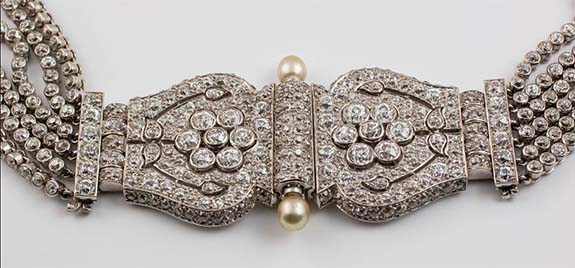
In additional to the extraordinary array of pearls, the necklace includes an Art Deco-era platinum clasp set with 428 old-mine diamonds. The diamond total weight of the piece is approximately 16 carats.
Mrs. Arthur Wallace Dunn was the wife of a prominent Washington, DC-based journalist and author, who hobnobbed with presidents Warren G. Harding, Theodore Roosevelt and Woodrow Wilson.
June's official gemstone — the pearl — is unique among all of the gems because it is the only one formed entirely within a living creature. Natural pearls occur when an irritant enters the oyster's shell. To protect itself from the foreign body, the mollusk secretes layers of nacre, which, over time, become a lustrous pearl. To make a cultured pearl, a shell bead is surgically implanted into the mollusk to induce nacre production.
Credits: Dunn Pearl Necklace by Donald E. Hurlbert/Smithsonian. Clasp closeup by Ken Larsen/Smithsonian.
Two years ago, we marveled at the size and opulence of the New England Patriots' fifth Super Bowl ring — a ring set with 283 diamonds weighing 5.1 carats. As expected, the team's sixth edition is even more over the top — with 422 diamonds weighing 8.25 carats and 20 blue sapphires totaling 1.60 carats.

Billed as the largest ring ever created in Super Bowl history, the unique football-shaped symbol of the team's winning tradition and championship legacy was presented to Patriots players, coaches, staff and executives by team chairman and CEO Robert Kraft during a private ceremony at his home this past Thursday.
The Patriots Super Bowl LIII championship ring, which was designed by Jostens, is likely the largest and most ornate ring ever created for any team in any sport. The 10-karat gold rings are also teeming with symbolism.

For example, 38 diamonds surround the iconic blue and red Patriots logo with an additional diamond set in the star. Combined, these 39 diamonds represent two NFL records achieved by the Pats with their Super Bowl LIII win. It was the franchise's 37th playoff victory — more than any other NFL team. In addition, they became the second team in NFL history to win six Super Bowls.
Sitting atop the Patriots logo are six Lombardi trophies, represented by marquise-cut diamonds outlined with 123 round diamonds. Providing a glistening background for the trophies are 108 pavé-set diamonds, which represent the number of practices held during the 2018 season. This symbol spotlights the team's focus on preparation — one diamond for every practice.
The words "WORLD" and "CHAMPIONS" flank the top of the ring in raised white gold lettering on a black ground. Exactly 76 diamonds — a patriotic nod to the 1776 birth date of the US — adorn the edges of the ring. Completing the intricate design are 20 round blue sapphires, which are emblematic of the Patriots 20 AFC East division championships.

The right side of the ring features the team's name above the Super Bowl LIII logo and includes the final score of the championship finale against the Los Angeles Rams, 13-3. The Patriots' rally cry of "STILL HERE," which the team embraced throughout the 2018-2019 playoffs, completes the design of the ring's right side.
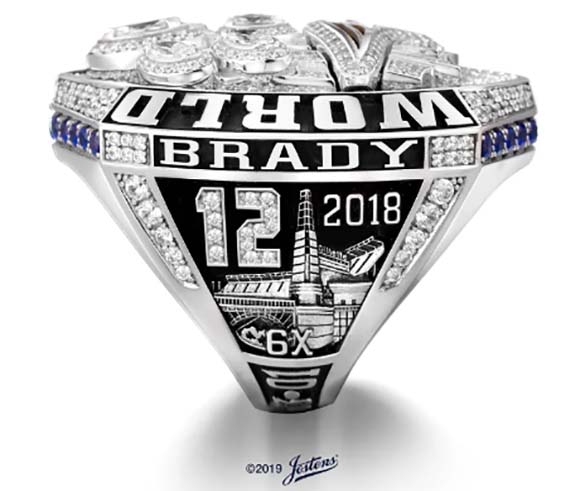
Appearing on the left side of the ring is the name of each recipient rendered in the official Patriots font. The name sits above a rendering of Gillette Stadium's signature lighthouse and bridge. To the left of the lighthouse is the player's uniform number, encrusted in diamonds. The franchise's sixth Super Bowl title is commemorated with a "6X" and dated 2018.

Robert Kraft's iconic quote and the team's foundational motto, "WE ARE ALL PATRIOTS," is inscribed inside the ring, along with Kraft's signature and the date he spoke those famous words. The palm crest features the years of the team's previous five championship seasons.
Credits: Images courtesy of Jostens.
Welcome to Music Friday when we bring you songs with jewelry, gemstones or precious metals in the title or lyrics. Today, in honor of June's official birthstone, we feature Canadian rock band The Trews singing their 2005 tune, "The Pearl (More Than Everything)."

In the song, lead singer Colin MacDonald refers to his love interest as "the pearl" and likens her beauty to a diamond ring.
He sings, "Though the pearl eludes me while I'm sinkin' still there's no finer thing / Diamonds do you justice only 'cause your beauty shines like a ring / I want you more than everything."
By the end of the song, MacDonald is even more determined to win her heart, singing, "Fighting through the winter tempest I can hear the sea sirens sing / Now I can find the gold and silver that I prayed tomorrow would bring."
Written by band members Colin MacDonald, John-Angus MacDonald and producer Gordie Johnson, "The Pearl" appeared as the eighth track of The Trews' Den of Thieves album. It was their second studio album and peaked at #6 on the Canadian Albums Chart.
The Trews were founded in Antigonish, Nova Scotia, in the late 1990s. They got their big break in the summer of 2002 when they won a contest sponsored by Ontario rock station CHTZ-FM. The victory led to a recording contract with Bumstead Productions.
The band was nominated as New Group of the Year at Canada's 2004 Juno Awards, and their tune "Not Ready to Go" was nominated as the Canadian Single of the Year in 2005. In November 2010, the band performed the Canadian National anthem at the 98th Grey Cup in Edmonton, which is equivalent to the Super Bowl in the US.
The Trews are currently appearing in venues throughout Ontario. Check out the video of their 2009 live performance of "The Pearl" at Glen Gould Studio in Toronto. The lyrics are here if you'd like to sing along...
"The Pearl (More Than Everything)"
Written by Colin MacDonald, John-Angus MacDonald and Gordie Johnson. Performed by The Trews.
The search of one true heart deep within you
The ocean will part the clearness of blue
Though the pearl eludes me while I'm sinkin' still there's no finer thing
Diamonds do you justice only cause your beauty shines like a ring
I want you more than everything
I want you more than everything
The four winds on high of virtue they sing
It sharpens my eye determines these things... determination
Though the pearl eludes me while I'm sinkin' still there's no finer thing
Diamonds do you justice only 'cause your beauty shines like a ring
Fighting through the winter tempest I can hear the sea sirens sing
I want you more than everything
I want you more than everything
I want you more than everything
I want you more than everything
I feel your heart fades into view
The mist pulls apart and reveals the...
Pearl eludes me while I'm sinkin' still there's no finer thing
Diamonds do you justice only 'cause your beauty shines like a ring
Fighting through the winter tempest I can hear the sea sirens sing
Now I can find the gold and silver that I prayed tomorrow would bring
I want you more than everything
More than everything
Ohhhhhhhhhh
More than everything
Ohhhhhhhh
More than everything
Ohhh ohhhhh
Credit: Screen capture via YouTube.com.
Exactly 100 years ago, a 19-year-old Antwerp engineer named Marcel Tolkowsky perfected a mathematical formula for the 57-facet "brilliant-cut" diamond. Tolkowsky's accomplishment prevails as the most iconic and successful cut in history due to its ability to maximize a diamond's fire, brilliance and sparkle.

The Antwerp World Diamond Centre recently held a street fair and ceremonial diamond cutting to honor Tolkowsky and the 100th anniversary.
"In 1919, my uncle Marcel unlocked the secret of light within a diamond," said Gabi Tolkowsky, one of the world's most renowned diamond cutters. "He figured out how to get the greatest amount of light to shine out of a diamond, calculating the number and arrangement of facets to maximize the light return. This was Marcel’s gift to the world, perfecting the journey of light, giving all those who came after him the knowledge of how to turn a diamond into a unique beauty."

Marcel Tolkowsky proved that if a diamond was cut too deep or too shallow, the light coming down from the top would escape out the sides or bottom, resulting in a loss of brilliance. His solution: 57 precisely placed facets cut to exacting proportions so the light coming into a diamond is refracted up through the table and crown to the viewer's eye.

During the celebration, the AWDC launched its unique “100 Years Brilliant” project, during which 57 well-know (and lesser known) Antwerp residents were invited to polish a single diamond — one person for each facet of a brilliant.
"In this way, ‘t Steentje – which is how the diamond industry is referred to in the local vernacular – will represent the multicultural character and diversity of the Antwerp diamond industry," explained AWDC CEO Ari Epstein.
Once the stone is finished, it will be exhibited in Antwerp's DIVA diamond museum.
The first facet was polished by guest of honor Gabi Tolkowsky, who famously spent three years cutting the 273.85-carat Centenary Diamond.
The second facet of the stone was polished by Constantinus ‘Stan’ Hunselmans, who shares his birth year with the brilliant.
“I celebrated my 100th birthday on January 14, and it is an honor that I was chosen," Hunselmans said. "It went really well. If I were a little bit younger, I might have considered a career switch.”
Since 1447, Antwerp has laid claim to the title of the "World's Diamond Capital." It should come as no surprise that Tolkowsky's brilliant cut was developed in this city.
Credit: Image courtesy of Petragems [CC BY-SA 4.0], via Wikimedia Commons. Diamond proportions graphics by Jasper Paulsen CC BY-SA 3.0, via Wikimedia Commons.
An engagement ring that was thought to be lost forever was returned to a Hueytown, Ala., woman by honest employees at a Kentucky distribution center of rugged men's apparel.
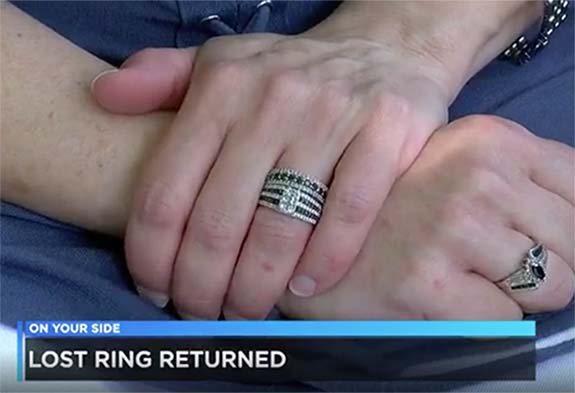
Jacky Crick, a receiver for Carhartt's return center in Hopkinsville, Ky., found the black and white diamond engagement ring in the pocket of a pair of jeans that had been sent to the facility by Andrea Speer.
Speer explained that she didn't feel the ring slip off as she prepared the return for her husband.
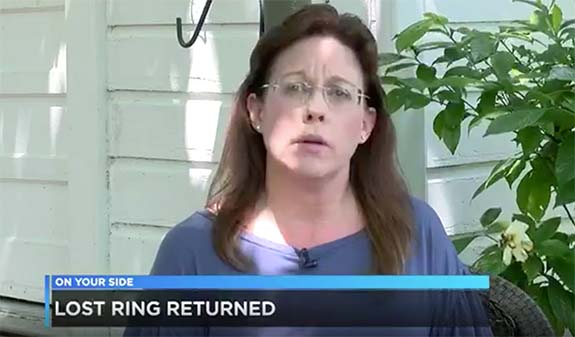
“The ring was loose," Speer told Birmingham TV station WBRC, "and I guess when I stuck my hand inside the pocket it just came off, and I didn’t notice it 'cause I still had the wedding band on.”
Speer was devastated by the loss.
“I went into panic mode and I cried myself to sleep that night and several nights after that because I was just heartbroken," she told WBRC. "You know it has sentimental value. I mean that’s the ring he put on my finger the day he proposed."
Speer was convinced, at first, that the ring came off during a shopping trip to a local Dollar store.
“Went back to the store three times, three times!" she exclaimed. "Looking in the store, looking in the parking lot, and it was nowhere to be found. And then after a couple of weeks we realized it’s probably just gone. I would never see it again.”

Little did she know, that 275 miles and two states away, an honest receiver was alerting her Carhartt's supervisor that she found the ring. That supervisor promptly shipped the ring back to Speer, along with a handwritten note on Carhartt stationery explaining how it was discovered.
Speer told the WBRC reporter how elated she and her husband were when the ring miraculously turned up in the mail...
“I cried, I was happy," she said. "I was just totally amazed and just totally relieved. [My husband] cried! He actually got back down on one knee and put it back on my finger. It was a very sweet moment, it was!”

Speer's stepdaughter, Brittany Scoggins, summarized the details of the unexpected ring return on her Facebook page.
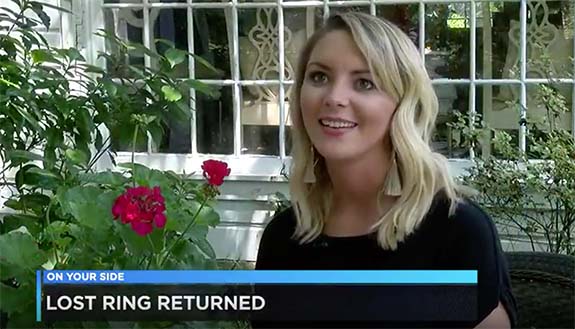
"People need to know that [Carhartt] is a good, honest company and that real people work there and real people want to do the right thing,” Scoggins told WBRC.
Speer said she'd like nothing more than to get up to Hopkinsville to give Crick a big hug.
Credits: Screen captures via wbrc.com.
An internally flawless bubble gum pink diamond weighing 3.44 carats was the colorful star of Christie's Hong Kong auction on Tuesday as it sold for $7.5 million, or $2.2 million per carat.
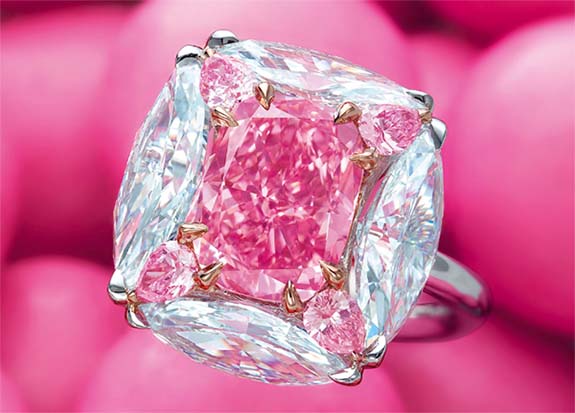
The cushion modified brilliant-cut diamond — aptly dubbed "The Bubble Gum Pink" — is set in a ring by luxury jeweler Moussaieff. The fancy vivid purplish-pink diamond is framed by small pear-shaped pink diamonds on the corners and larger marquise-cut white diamonds on the sides.
Celebrated for its superb color, The Bubble Gum Pink was classified by Christie's Chairman Francois Curiel as "probably the strongest pink I have ever seen in my 50-year life of jewelry specialty at Christie’s."
The hammer price for the auction's top lot was on the high end of Christie's pre-sale estimate of $6 million to $8 million.
Other top lots at the Magnificent Jewels event include the following:

• A pair of emerald earrings called The Grand Muzos fetched $4.5 million. The Colombian-sourced emeralds weigh 23.34 carats and 23.18 carats, respectively, and are accented by white diamonds and pearls. Each of the diamonds weighs exactly 3.01 carats and share identical F-color and VS2 clarity gradings. Christie's had estimated the pair would sell in the range of $3.8 million to $6.5 million.

• A necklace featuring 47 jadeite beads ranging in size from 9.8mm to 13.3mm and accented with a ruby and diamond clasp yielded $1.9 million, slightly below the pre-sale estimate of $2 million to $3 million. The necklace measures 22.24 inches (56.5cm) in length.
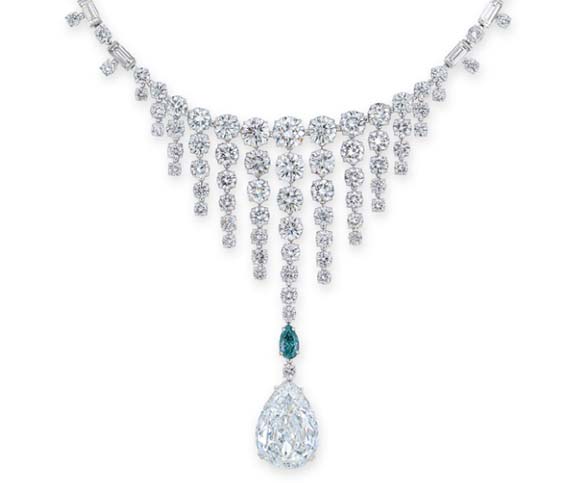
• An elaborate diamond necklace by Bulgari — highlighted by a rare 1.02-carat vivid green-blue modified brilliant-cut diamond and a modified pear brilliant-cut diamond of 11.69 carats — sold for $1.57 million. The large center diamond is internally flawless. The hammer price was just below the pre-sale estimate, which Christie's set at $1.6 million to $2.3 million.
The Christie's Magnificent Jewels sale in Hong Kong presented more than 260 lots and netted $44.4 million.
Credits: Images courtesy of Christie's.